


AI Is Your New Sales Rep, But Only If You Feed It The Right Data
04 May 2026
 Albert Wood

B2B buying has changed significantly. Today, your first “sales interaction” often isn’t with a human representative. It happens through AI tools like ChatGPT, Perplexity AI, and many other AI search engines, where buyers research, compare options, and shortlist the vendors before ever visiting their websites.
Welcome to the new reality. Now, AI isn’t just assisting decisions, it’s actually shaping them.
According to a recent press release from PR Newswire, 73% of B2B buyers have already been using AI tools in their research process.
But AI doesn’t think like your sales team. It doesn’t interpret vague product descriptions, chase missing specifications, or reconcile inconsistent pricing across systems. It relies entirely on structured, accurate, and accessible data.
If your product catalog isn’t standardized, your pricing isn’t aligned, or your inventory visibility is limited, AI won’t recommend your business to the target audience. Therefore, brands that are gaining visibility on AI tools aren’t necessarily more visible; they’re more structured.
This blog helps you understand what AI needs to effectively “sell” for you, and how to build a data foundation that makes your business more discoverable, comparable, and ready for AI-driven buying journeys.

The Shift from Human Sales Reps to AI Decision-Makers
For years, B2B sales relied on relationships. Sales representatives knew the accounts, understood buying cycles, and guided clients in decision-making conversations. This layer still exists, but it’s no longer the starting point.
With AI, there is a shift in the buying journey of B2B customers. They prefer to evaluate and shortlist the vendors based on AI tools’ recommendations.
How AI Agents Evaluate Vendors and Products
AI engines like ChatGPT and Perplexity don’t “browse” the way humans do. They analyze structured data at scale to deliver fast and confident recommendations.
AI is typically:
- Aggregate product data from multiple sources (eCommerce platforms, PIM, ERP)
- Normalize attributes for accurate comparison
- Validate pricing, availability, and compatibility
- Rank options based on relevance, completeness, and clarity
Within seconds, AI can produce a list of specific vendors and products. If a buyer does it through a normal search engine, it would take hours to compile the details and make a decision.
From Sales Conversations to Machine Decisions: What’s Really Changing?
The shift isn’t about replacing your sales team; it’s about redefining how opportunities begin. Discovery is no longer driven by conversations alone. It’s driven by data that AI can read, validate, and act on instantly.
| Traditional Sales Model (Human-Led) | AI-Powered Sales Model (Machine-Led) |
|---|---|
| Relationship-driven selling | Data-driven AI recommendations |
| Sales rep interprets ambiguous specifications | AI requires structured and queryable attributes |
| Follow-up emails and calls after RFQ | No follow-up. AI moves on instantly |
| Months-long nurture cycle | Shortlist generated in seconds |
| Vendor known through personal contact | Vendor surfaced through clean data feeds |
AI tools don’t “build relationships,” they evaluate data clarity. If your data aligns with what these systems need, you get surfaced at the right moment. If it doesn’t, you’re invisible, regardless of brand reputation or past relationships.
Why Incomplete or Unclear Data Disqualifies You Instantly
AI has zero tolerance for ambiguity. It won’t infer missing details or chase clarification.
Common disqualifiers include:
- Missing or inconsistent product specifications
- Unstructured or vague descriptions
- Pricing is hidden behind “Request a Quote” forms
- Inventory that isn’t real-time or reliable
- Data silos across ERP, CRM, and eCommerce systems
Each gap introduces uncertainty, and AI avoids uncertainty.
The result is simple: incomplete data doesn’t slow the sale; it removes you from consideration entirely.
In this new environment, the question isn’t whether your sales team is effective. It’s whether your data is strong enough to earn you a place in the conversation before your team even gets involved.

What AI Needs to Recommend Your Products
AI isn’t reading your homepage or interpreting brand messaging. It answers a buyer’s query by parsing data, without assumptions. AI search tools surface products based on what they can clearly understand, compare, and validate. If your data isn’t structured for that process, you won’t appear in search results.
To consistently appear and compete in AI-driven shortlists, four data layers must be complete, accurate, and machine-readable:
Structured Product Data: The Entry Ticket
This is non-negotiable. AI relies on clearly defined attributes, not descriptive paragraphs.
- Discrete and Standardized Fields (dimensions, weight, materials, tolerances)
- Technical Specifications and Performance Thresholds
- Certifications and Compliance Details
- Consistent Taxonomy across your Catalog
Think of this as database-ready details, not marketing copy. If attributes are missing or inconsistent, AI can’t confidently match your product to a query.
Transparent Pricing Model: The Comparison Layer
AI cannot evaluate what it can’t quantify.
- Clear Base Pricing (not “request a quote”)
- Tiered Pricing Structures and Volume Breaks
- Defined Discount Logic and Conditions
- Standardized Formats for Easy Comparison
If pricing is hidden or fragmented across systems, AI deprioritizes your products in favor of vendors with clear and comparable data.
Real-Time Inventory Signals: The Availability Filter
AI prioritizes what can actually be purchased, now.
- Live Inventory Levels.
- Accurate Availability Status.
- Lead Times & Fulfillment Windows.
- Location-Based Stock Visibility (if applicable).
Recommending an unavailable product damages trust, so AI systems favor vendors with reliable and up-to-date inventory signals.
Contextual Data: The Decision Driver
This is what moves you from “eligible” to “recommended.”
- Use Cases and Application Scenarios
- Compatibility and Integration Details
- Configuration Rules and Product Relationships
- Technical Notes that Guide Selection
Without context, your product may technically match a query, but it won’t stand out as the best fit.
When these four layers work together, AI can confidently interpret, compare, and recommend your products in real buying moments. If even one layer is incomplete or inconsistent, your chances drop sharply, not because your offering isn’t strong, but because it isn’t clear.
In an AI-driven buying journey, clarity isn’t a competitive advantage; it’s the baseline for being considered.
When these four layers work together, AI can confidently interpret, compare, and recommend your products in real buying moments. If even one layer is incomplete or inconsistent, your chances drop sharply, not because your offering isn’t strong, but because it isn’t clear.
In an AI-driven buying journey, clarity isn’t a competitive advantage; it’s the baseline for being considered.
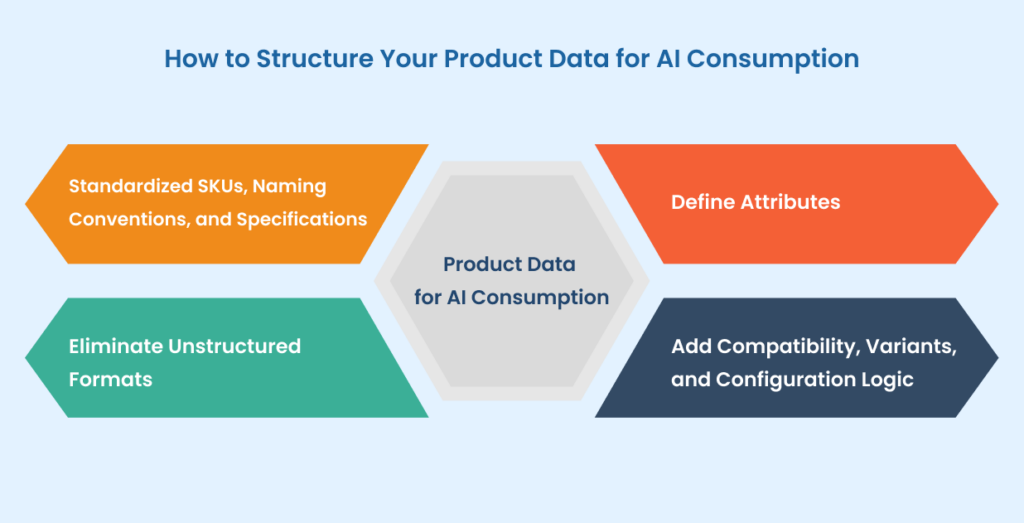
How to Structure Your Product Data for AI Consumption
Most B2B catalogs were built for human sales representatives, PDFs, and product sheets. AI, however, requires something very different: structured, consistent, and machine-readable data. AI engines don’t interpret loosely written content. These tools match, compare, and validate structured inputs. If your product data isn’t organized that way, it won’t be used.
Standardized SKUs, Naming Conventions, and Specifications
Consistency is the foundation of AI readability.
- Assign a single and canonical product name across all platforms
- Maintain a clean, unique, and non-duplicated SKUs
- Use uniform naming conventions across the ERP, PIM, and eCommerce systems
- Standardize how specifications are labeled and formatted
If the same product appears differently across systems, AI treats it as unreliable or unrelated.
Define Attributes (Dimensions, Materials, and Performance Metrics)
AI evaluates products based on measurable data, not descriptive language.
- Capture dimensions, weight, and material composition in structured fields
- Include performance metrics (e.g., pressure ratings, temperature limits, load capacity)
- Define tolerances, certifications, and compliance details
- Avoid vague terms like “high quality” or “heavy-duty”
The more precise your attributes, the easier it is for AI to match your product to a buyer’s requirements.
Add Compatibility, Variants, and Configuration Logic
Complex products need structured relationships, not creative naming.
- Group variants (size, material, or finish) under a single parent product
- Define compatibility with specific models, systems, or standards
- Map configuration rules and dependencies clearly
- Ensure variant combinations are logically structured and searchable
This allows AI to understand not just what your product is, but how and where it fits.
Eliminate Unstructured Formats (PDFs, Images, and Static Documents)
If AI can’t understand your product data format, it can’t recommend your products.
- Convert PDF specification sheets into structured and indexable data
- Avoid image-based specifications and scanned documents
- Replace static files with dynamic data feeds or accessible databases
- Ensure product information is available in formats AI can read and compare
Unstructured formats hide critical information from AI systems, which makes your products invisible.
| What AI Can’t Read | What AI Needs |
|---|---|
| “Durable and long-lasting” | “Material: Stainless Steel (Grade 304)” |
| “Fits most bags” | “Dimensions: 10in (H) × 3in (W)” |
| Product details in a PDF brochure | Structured fields: material, capacity, dimensions |
| Separate listings like “Blue Bottle Large”, “Red Bottle Medium” | One product with variants: Color × Size |
| SKU like “BOTTLE-BIG-BLUE” | Canonical SKU: WB-750ML-SS-BL |
| Images showing features (no text data) | Attribute fields: Capacity: 750ml, Insulated: Yes |
Structured data isn’t a technical upgrade; it’s a visibility requirement. The more standardized, detailed, and accessible your product data is, the more likely AI is to evaluate, match, and recommend your products in real buying scenarios.

Pricing Data: From Hidden Quotes to AI-Readable Logic
B2B pricing has never been simple, and that’s not the problem. Volume discounts, customer-specific contracts, and regional variations are standard across industries.
Earlier, this complexity worked because sales reps understood how to interpret and apply pricing rules in real time. But AI doesn’t “interpret.” It executes. And it can only execute what’s clearly defined.
The RFQ Model: A Dead End for AI
This is where the traditional “Request a Quote” model breaks down.
- For a human buyer, an RFQ is the start of a conversation.
- For AI, it’s the end of the road.
When AI tools encounter missing or hidden pricing, they don’t wait for clarification; they move on to vendors whose pricing can be immediately evaluated. There’s no follow-up, no second touchpoint, and no opportunity to recover that lost visibility.
From Pricing Conversations to Pricing Logic
To participate in AI-driven buying, pricing needs to shift from being conversational to computational. That means expressing pricing as structured logic rather than implicit knowledge.
Instead of relying on phrases like “bulk discounts available,” the rules must be defined for quantity thresholds, corresponding price tiers, eligibility conditions, and discount structures so that systems can process formatted data easily.
Making Contract Pricing Machine-Accessible
The same applies to contract pricing. Personalized pricing doesn’t disappear in an AI-driven environment, but it must be accessible in real time. When pricing is locked in spreadsheets, PDFs, or internal systems, it becomes invisible to AI.
Forward-looking organizations are solving this by connecting their ERP pricing engines directly to their eCommerce platforms. Share accurate and updated pricing with customers that is dynamically calculated based on customer identity, order volume, and predefined business rules.
Real-Time Pricing as a Competitive Signal
What emerges from this shift is more transparent pricing. And that distinction matters. Because, in an AI-first buying journey, pricing isn’t just a negotiation tool; it’s a qualification signal.
If your pricing can’t be accessed, calculated, and compared instantly, your products won’t make it into the decision set at all.
In this new buying environment, pricing isn’t something you reveal later. It’s something that determines whether you’re considered or not. The companies that win aren’t the ones with the most competitive pricing alone, but the ones whose pricing can be understood instantly, evaluated accurately, and trusted by machines.
If AI can read your pricing, you stay in the game. If it can’t, you’re out before the conversation even begins.

How Does Real-Time Inventory Data Determine Visibility
Inventory is where many B2B businesses quietly lose opportunities they never even see. AI doesn’t just evaluate what you sell, it evaluates whether you can deliver it right now. And AI systems are designed to favor vendors whose availability data is consistently reliable.
AI Prioritizes Vendors with Reliable Availability
AI is optimized to avoid risk. Recommending an out-of-stock product creates a poor experience, so these systems learn quickly which vendors provide dependable inventory data.
Over time, this creates a clear distinction:
- Vendors with accurate data get surfaced more often
- Vendors with inconsistent data gradually disappear from recommendations
Trust, in this context, is built entirely on data accuracy.
Syncing Inventory Across Warehouses and Channels
Inventory doesn’t live in one place, and neither should its updates.
For AI to rely on your data, stock levels must stay synchronized across:
- Warehouses and Distribution Centers
- ERP and eCommerce Platforms
- APIs, Feeds, and Marketplace Listings
If a product goes out of stock in one location, that change must reflect everywhere almost instantly. Delayed updates create mismatches, and even small mismatches reduce AI confidence.
Handling Backorders, Lead Times, and Regional Availability
Availability is more than “in stock” or “out of stock.” AI needs structured signals to evaluate whether a product is a viable option.
That includes:
- Defined lead times as structured fields (not vague phrases)
- Clear backorder rules (allowed, conditional, or restricted)
- Region-specific availability is mapped explicitly
- Fulfillment timelines tied to actual inventory conditions
The more precise your availability data, the easier it is for AI to assess and recommend your products.
Reducing Lost Opportunities from Outdated Stock Data
Inventory gaps don’t just affect fulfillment; they impact discoverability.
When your data is outdated:
- AI may recommend unavailable products → trust drops
- Future recommendations decrease
- You lose opportunities without knowing they existed
When your data is accurate:
- AI continues to surface your products
- Buyers see you as a reliable option
- You stay in the consideration set
In an AI-first commerce environment, inventory accuracy isn’t just an operational metric; it’s a direct opportunity for revenue and visibility.
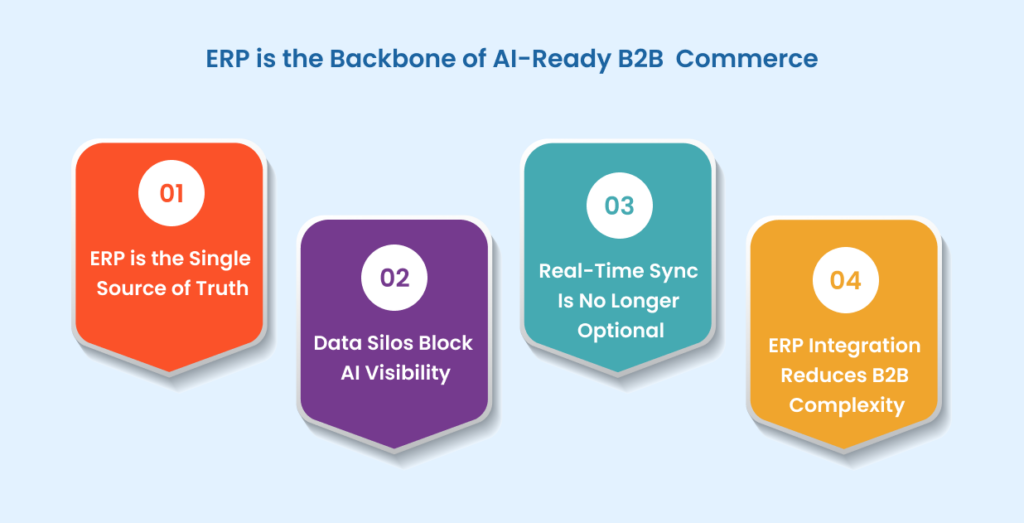
The Role of ERP in Powering AI-Ready Data
For most B2B organizations, the ERP system already holds everything AI needs to evaluate and recommend your business, product data, pricing logic, inventory, and customer-specific rules. The issue isn’t the absence of data. It’s the lack of connection.
When ERP data remains isolated from your eCommerce and digital channels, it becomes invisible to the very systems shaping buying decisions.
ERP is the Foundation of Data Integrity
Your ERP is where operational truth lives. It defines what you sell, how you price it, where it’s stocked, and which customers see what. This makes it the most reliable source of structured data in your ecosystem. However, reliability alone isn’t enough.
For AI to use this data, it must be continuously accessible and aligned across every customer-facing touchpoint. If your ERP holds accurate data but your storefront shows something different, AI will trust neither.
The Hidden Cost of Data Silos
Disconnected systems create delays that are easy to overlook but costly in impact. A pricing update approved in your ERP may take hours or even days to appear on your website. Inventory changes at the warehouse level might not reflect online until a manual sync is triggered. These gaps create inconsistencies, and in an AI-driven environment, inconsistency signals risk.
AI systems don’t attempt to reconcile conflicting data. They simply prioritize vendors whose information is current and dependable. That means every delay caused by siloed systems quietly reduces your chances of being recommended.
Real-Time Synchronization as a Business Requirement
What used to be considered a technical enhancement, real-time integration, is now foundational to visibility. When your ERP is tightly integrated with your eCommerce platform, changes propagate automatically.
A discontinued product is removed from listings without delay. Updated pricing rules reflect instantly for the right customer segments. Inventory adjustments flow across all channels in near real time.
This level of synchronization ensures that AI systems always interact with accurate and up-to-date data. And that consistency directly impacts whether your products are surfaced in buying decisions.
Enabling Complex B2B Logic Through Integration
B2B commerce rarely follows simple rules. Customer-specific pricing, multi-location inventory, drop-shipping conditions, and minimum order quantities are all part of everyday operations. These complexities are typically managed within the ERP, but unless they are exposed through structured integrations, they remain inaccessible to AI.
When properly integrated, your ERP doesn’t just store this logic; it actively delivers it. AI can then evaluate not just whether a product exists, but whether it’s available under the right conditions for a specific buyer. That’s the difference between being technically listed and being meaningfully recommended.
From Backend System to Growth Enabler
As AI continues to shape how buyers discover and evaluate vendors, the role of ERP is evolving. It’s no longer just a backend system of record. It becomes the engine that powers real-time and decision-ready data across your entire commerce ecosystem.
In this context, ERP integration isn’t about efficiency alone; it’s about eligibility. Because if your data can’t move fast enough to keep up with AI-driven evaluation, it won’t be part of the decision-making process at all.
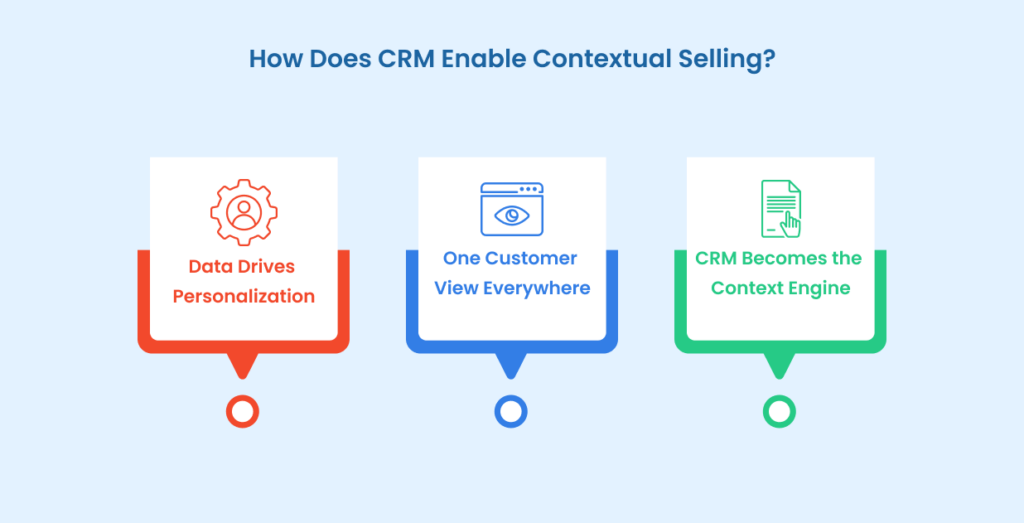
Connecting CRM for Contextual Selling
If product data tells AI what you sell, CRM data tells who is buying it and why that matters. Without this layer, AI can only generate generic recommendations. With it, those recommendations become contextual, relevant, and far more likely to convert. AI engines deliver the most value when they can combine product intelligence with real customer context.
Turning Customer Data into Relevant Recommendations
A well-integrated CRM transforms static product matching into dynamic and personalized selling.
- Surface customer-specific or contract pricing instead of generic list prices
- Recommend accessories, consumables, or upgrades based on purchase history
- Align suggestions with customer preferences, order patterns, and usage behaviors
This is the kind of account-level intelligence that once depended on experienced sales reps, now made scalable through data.
Creating a Unified Buyer Experience
When CRM data is fragmented, the buyer experience feels disjointed. When it’s unified, every interaction becomes consistent and reinforcing.
- Align AI recommendations with marketing campaigns and sales conversations
- Ensure consistent pricing, messaging, and product visibility across channels
- Eliminate conflicting information across touchpoints
The result is a smoother and more trustworthy buying journey.
From Sales Tools to Context Engines
CRM is no longer just a pipeline management system. It’s the context layer that powers meaningful engagement.
| Without CRM Integration | With CRM Integration |
|---|---|
| AI shows the public list price to every buyer | AI surfaces negotiated contract rate for known accounts |
| Generic product suggestions | Recommendations based on purchase history and behavior |
| Disconnected sales, marketing, and AI interactions | Coherent buyer experience across every touchpoint |
| Every interaction starts from scratch | AI carries context, account, history, and preferences |
| Manually managed customer-specific catalogs | Automatically personalized product and pricing views |
This shift is what elevates your experience from “functionally correct” to genuinely useful, where every recommendation feels informed, not random.

APIs: The Backbone of AI-Driven Commerce
One of the biggest shifts in B2B commerce is happening behind the scenes: AI systems don’t prefer websites; they prefer direct data access. Instead of navigating pages, they query structured endpoints. And that’s exactly what APIs provide.
Why AI Prefers APIs Over Web Pages
Websites are built for human browsing. APIs are built for machine consumption.
When AI platforms evaluate your catalog, parsing HTML is inefficient and error-prone. APIs, on the other hand, return clean, structured, and consistent data, exactly what AI needs to process queries, compare options, and generate recommendations quickly.
This is why businesses relying solely on traditional and content-heavy websites are at a disadvantage. If your data isn’t accessible programmatically, it’s harder for AI to use and easier to ignore.
From Static Websites to API-First Ecosystems
The shift isn’t about replacing your website. It’s about expanding how your data is delivered.
In an API-first model:
- Product, pricing, and inventory data are exposed as structured endpoints
- AI agents and procurement systems can query data directly
- Updates are reflected instantly without manual intervention
This creates an ecosystem where both humans and machines can access the same reliable information, each in the format they need.
Enabling Seamless Integrations at Scale
APIs also simplify how you connect with external systems, marketplaces, procurement platforms, partner networks, and AI tools.
Instead of building custom exports for every new integration, you expose a single and well-documented API. Any system can connect, retrieve data, and stay updated in real time. This not only reduces operational overhead but also accelerates your ability to participate in new channels.
Invisible Interactions, and Real Impact
In many cases, AI-driven interactions happen without your team ever seeing them. A buyer’s AI agent queries your API, evaluates your data, and includes you in a recommendation, all in seconds, without a form fill or sales inquiry.
That’s the new reality: decisions are being shaped before conversations begin.

Common Data Mistakes that Block AI Recommendations
Most B2B businesses aren’t falling behind because they lack AI; they’re being filtered out because of compounding data issues that make them hard to evaluate. AI systems don’t attempt to fix messy or inconsistent inputs. They prioritize clarity and quietly exclude everything else.
Inconsistent Product Naming and Missing Attributes
The same product appears with different names across your website, ERP, and marketplace listings. Some SKUs have detailed attributes, others are incomplete. Without consistent identifiers and complete data, AI cannot reliably match or recommend your products.
Outdated or Siloed Pricing and Inventory
Pricing agreed in sales conversations never reaches your digital channels. Inventory updates rely on periodic exports or manual uploads. These gaps lead to incorrect pricing, unavailable product recommendations, and reduced trust from AI systems.
No Standardization Across Systems
Different teams define and structure data differently; engineering, marketing, and operations all use their own conventions. Without a unified taxonomy, your data becomes fragmented, making it difficult for AI to aggregate, compare, or surface accurately.
Over-Reliance on Manual Processes and Static Content
Spec sheets stored as PDFs, pricing shared via email, and inventory tracked in spreadsheets may have worked in the past. In an AI-driven environment, these formats act as barriers. If data isn’t structured and accessible, it isn’t usable.
Each of these challenges is solvable, but not through quick fixes. It requires intentional data governance, tighter system integration, and a shift toward treating data as a core business infrastructure.

Building an AI-Ready Data Infrastructure
Becoming AI-ready isn’t a one-time project; it’s a structural shift in how your business manages and delivers data. The payoff is cumulative: better visibility, stronger recommendations, and more consistent growth.
Data Normalization and Enrichment
Start by auditing your existing catalog. Identify missing attributes, inconsistent naming, and incomplete specifications. Then, enrich systematically by adding structured fields, standardizing taxonomy, and aligning with industry schemas where applicable. This transforms scattered data into something AI can interpret and trust.
Unified Product, Pricing, and Inventory Models
Break down silos between ERP, CRM, PIM, and eCommerce systems. Establish a single, authoritative product record that feeds all downstream platforms. Updates should propagate automatically, ensuring consistency across every touchpoint without manual intervention.
Multi-Channel Scalability
B2B buyers now operate across multiple environments, including your website, marketplaces, procurement platforms, and AI-driven tools. Your data infrastructure must support all of them simultaneously, delivering consistent, real-time information regardless of where the interaction happens.
Prepare for Agentic Commerce
AI is moving beyond recommendations to execution. Agentic commerce, where AI systems evaluate, select, and complete transactions, is already emerging. The structured, integrated data foundation you build today is what will enable these automated procurement workflows tomorrow.
The direction is clear: businesses that treat data as infrastructure will be the ones AI can discover, evaluate, and recommend. The rest will struggle to stay visible.

Since 2004, ioVista has helped B2B organizations build and evolve their commerce ecosystems with a focus that goes far beyond front-end design. The real driver of visibility today is data, how it’s structured, connected, and delivered across systems.
That’s the foundation we prioritize, because it’s what enables discovery, evaluation, and recommendation across modern channels, including AI.
API-First Replatforming
ioVista builds commerce environments designed for both human buyers and machine consumption.
By implementing API-first and headless architectures, we ensure your product, pricing, and inventory data are accessible in clean, structured formats, ready to support AI tools, marketplaces, and future integrations without rework.
Deep ERP and CRM Integration
We provide ERP integration and CRM integration directly to your commerce layer, eliminating silos and delays. This ensures that pricing updates, inventory changes, and customer-specific data flow in real time across every touchpoint, creating a consistent and reliable data environment that AI systems can trust.
Product Data Structuring and Enrichment
Our team audits and transforms your product catalog into a structured, standardized, and complete dataset.
From normalizing taxonomy to enriching attributes and defining variant logic, we make your data usable, not just readable, so AI systems can accurately evaluate and recommend your products.
AI Discoverability and Optimization
From optimizing your data for platforms like ChatGPT to enabling integrations with emerging AI-driven procurement tools, ioVista ensures your business is positioned for how buyers discover vendors today and how they will be discovered tomorrow.
ioVista enables AI-ready commerce by structuring product data, integrating ERP and CRM systems, and delivering real-time pricing and inventory through APIs. This ensures platforms like ChatGPT can accurately evaluate and recommend your products.
With a focus on data clarity and system connectivity, ioVista helps you stay visible in AI-driven buying journeys. Are you ready to be recommended, not overlooked? Connect with ioVista today.
Frequently Asked Questions
Why is structured data important for AI-driven B2B commerce?
Structured data allows AI systems to accurately interpret, compare, and recommend your products. Without standardized attributes, pricing, and inventory signals, your business may not appear in AI-generated shortlists.
How does AI evaluate and recommend B2B vendors?
AI tools analyze structured product data, pricing logic, availability, and relevance to buyer queries. They prioritize vendors with complete, consistent, and machine-readable data across systems and channels.
Can AI recommend my products if I use “Request a Quote” pricing?
In most cases, no. AI systems cannot interpret hidden or unstructured pricing. Transparent, structured pricing models are essential for being evaluated and recommended in AI-driven buying journeys.
What role do ERP and CRM systems play in AI readiness?
ERP and CRM systems provide the core data for products, pricing, inventory, and customer context. When integrated with your commerce platform, they enable real-time, accurate data flow that AI systems rely on.
How can I make my B2B business AI-ready?
Start by structuring your product data, enabling real-time pricing and inventory updates, integrating ERP/CRM systems, and adopting an API-first architecture. This ensures your data is accessible, consistent, and usable by AI systems.
Albert Wood


Albert Wood is an accomplished eCommerce Business Analyst. As a technology futurist and sales motivator at ioVista, Albert is dedicated to transforming struggling eCommerce businesses into thriving enterprises. With a keen focus on client’s business processes, user experience (UX), and leveraging the power of digital marketing, he helps businesses optimize their online presence and drive sustainable growth. Albert’s passion is for virtual reality (VR), augmented reality (AR), and mixed reality (MR), immersing himself in unforgettable experiences and exploring the limitless possibilities they offer. His enthusiasm for these emerging technologies fuels his drive to push the boundaries of innovation in eCommerce.
Popular Posts
-
 News
NewsInternational Manufacturing Technology Show: What Manufacturing Taught Us About Technology, Change and the Future

Aaron Pallares
29 Sep 2026 -
B2B, BigCommerce
BigCommerce B2B Edition Explained: Features, Pricing and Fit

Mike Patel
21 Sep 2026 -
BigCommerce, Migration, Shopify
BigCommerce vs. Shopify for B2B: A 2026 Decision Guide
Mike Patel
18 Sep 2026 -
AI and ML, AIO, B2B, E-Commerce
The Role of AI in Modern eCommerce: A B2B and B2C Guide
Aaron Pallares
16 Sep 2026 -
Shopify
Do You Need a Shopify Agency? A Guide for Growing B2B & D2C Businesses
Aaron Pallares
14 Sep 2026 -
Update
Adobe Commerce APSB26-138: What Businesses Need to Know About the Security Update
Albert Wood
10 Sep 2026 -
Adobe Commerce
Adobe Commerce APSB26-146: Critical Security Fixes Require Urgent Action
Albert Wood
08 Sep 2026 -
Adobe Commerce, SEO
Magento 2 SEO Guide for 2026: Advanced Strategies to Boost Rankings and Performance
Albert Wood
07 Sep 2026 -
-
-
-
Shopify
When Commerce Policies Change: What Regulated Merchants Can Learn from Shopify's Vape Decision
Albert Wood
18 Aug 2026 -
Adobe Commerce
Adobe Commerce APSB26-92: Security Risks, Affected Versions, and Next Steps
Albert Wood
13 Aug 2026 -
-
News
How ShopWare and ioVista are Driving Digital Transformation in the 2A Community!
Aaron Pallares
04 Aug 2026 -
News
Why ioVista Became a Shopware Partner: Building the Future of Digital Commerce Through Innovation and Collaboration
Aaron Pallares
28 Jul 2026 -
Adobe Commerce, Magento, Update
Critical Adobe Commerce Security Update APSB26-73: Key Highlights
Mike Patel
15 Jul 2026 -
AI and ML, Google Updates
Google Marketing Live 2026: Everything You Need to Know about Google's AI Advertising Revolution
Mike Patel
16 Jun 2026 -
Adobe Commerce
Critical Adobe Commerce Security Update APSB26-49: Key Highlights
Mike Patel
15 May 2026 -
Adobe Commerce
Adobe Commerce 2.4.9 is Here: Features, Security, and Platform Enhancements
Mike Patel
15 May 2026 -
-
-
-
AI and ML, AIO, B2B
Machine-Readable B2B: The Hidden Layer that Wins AI Visibility
Mike Patel
14 Apr 2026 -
B2B
AI-Ready Catalogs: Turning Your Product Data into a Recommendation Engine
Mike Patel
09 Apr 2026 -
-
-
AIO, SEO
LLM Optimization: How Large Language Models Discover, Rank, and Cite Content
Mike Patel
26 Mar 2026 -
Migration, SEO
SEO Website Migration Checklist: Guide to Protect Your Rankings & Traffic in 2026
Mike Patel
13 Mar 2026 -
Adobe Commerce, Update
Adobe Commerce Security Update APSB26-05: Everything You Need to Know
Mike Patel
12 Mar 2026 -
AIO, SEO
LLM SEO vs GEO vs SEO: What Actually Matters for eCommerce Brands in 2026
Mike Patel
12 Mar 2026 -
Adobe Commerce
Are You Still on Adobe Commerce 2.4.6? Now is the Time to Upgrade
Mike Patel
24 Feb 2026 -
-
-
-
-
AI and ML, SEO
AI-SEO Is Changing Everything in 2026: 5 Strategies to Rank and Stay Relevant
Mike Patel
10 Dec 2025 -
-
E-Commerce
What SEMA 2025 Revealed: The Digital Transformation Race in the Automotive Aftermarket Industry
Mike Patel
20 Nov 2025 -
Adobe Commerce
Most Exciting Update: Hyvä Theme is Now Open Source and FREE
Paren Sutreja
17 Nov 2025 -
News, Shopify
Breakthrough Update: Managing Product Variants on Shopify Got Easier with 2048 Variants
Mike Patel
11 Nov 2025 -
Adobe Commerce, Update
Critical Adobe Commerce Vulnerability (CVE-2025-54236): What Merchants Need to Know
Mike Patel
27 Oct 2025 -
Adobe Commerce, Update
Adobe Commerce Security Update APSB25-94: What You Need to Know
Mike Patel
15 Oct 2025 -
Shopify
The Quiet Revolution: Why the Shopify x ChatGPT Partnership Changes Everything in eCommerce
Mike Patel
03 Oct 2025 -
Adobe Commerce
Adobe Sensei AI in eCommerce 2025: Transforming Digital Commerce
Mike Patel
19 Sep 2025 -
Adobe Commerce
Critical Adobe Commerce Security Update APSB25-88: Key Highlights
Mike Patel
10 Sep 2025 -
Shopify
Shopify API Deprecations and New Features: A Merchant's Guide to Upcoming Changes
Mike Patel
08 Sep 2025 -
AI and ML
Agentic AI for Business - Drive Success with Intelligent Automation
Mike Patel
27 Aug 2025 -
Adobe Commerce, Update
Adobe Commerce Security Update APSB25-71: Essential Security Fixes You Need to Know
Mike Patel
13 Aug 2025 -
News, Shopify
Shopify Summer Edition 2025: A Technical Insight into the Latest Update
Mike Patel
08 Aug 2025 -
-
Adobe Commerce, Magento
Adobe Commerce Security Update APSB25-50: Key Highlights
Mike Patel
11 Jun 2025 -
Adobe Commerce, B2B, E-Commerce
B2B Excellence Starts with Adobe Commerce (Magento) - Not WooCommerce
Mike Patel
03 Jun 2025 -
AI and ML, B2B, Digital Marketing, E-Commerce, Web Development
AI and ML in B2B: A Vision for the Future of Commerce by 2025
Mike Patel
27 May 2025 -
B2B, Digital Marketing, E-Commerce, Web Development
20 Next-Gen B2B eCommerce Features that will Dominate in 2025
Mike Patel
20 May 2025 -
B2B, BigCommerce, E-Commerce, Web Development
WooCommerce to BigCommerce Migration Fuels Your B2B eCommerce Growth
Mike Patel
06 May 2025 -
Adobe Commerce, E-Commerce, Migration, News, Web Development
Adobe Commerce SaaS: How Will It Empower Your eCommerce Business?
Mike Patel
22 Apr 2025 -
B2B, E-Commerce, Web Development
Leverage ERP Integration to Scale Your B2B eCommerce Business in 2025
Mike Patel
15 Apr 2025 -
Adobe Commerce, E-Commerce, Magento, News, Web Development
Adobe Commerce Security Update APSB25-26: All You Need to Know
Mike Patel
10 Apr 2025 -
Adobe Commerce, E-Commerce, Magento, News, Web Development
Adobe Commerce 2.4.8 Release: Key Highlights
Mike Patel
10 Apr 2025 -
B2B, E-Commerce, Migration, Web Development
Why Scaling Business Should Migrate WooCommerce Stores to Shopify
Mike Patel
08 Apr 2025 -
Adobe Commerce, B2B, E-Commerce, Magento, Web Development
Why Does Adobe Commerce (Magento) Lead the Way of B2B eCommerce
Mike Patel
18 Mar 2025 -
B2B, Digital Marketing, E-Commerce, Web Development
Gain a Competitive Edge by Turning Obstacles into Opportunities: B2B Digital Transformation in 2025
Mike Patel
11 Mar 2025 -
AI and ML, B2B, Digital Marketing, E-Commerce, Web Development
10 Key Drivers of Digital Transformation in B2B eCommerce for 2025
Mike Patel
04 Mar 2025 -
B2B, E-Commerce, Web Development
5 Leading eCommerce Platforms to Build Scalable B2B Customer Portals
Mike Patel
25 Feb 2025 -
Google Updates, News, SEO
Google Search Ranking Volatility: All You Need to Know
Mike Patel
18 Feb 2025 -
Adobe Commerce, E-Commerce, Magento, News, Web Development
Adobe Commerce Security Update APSB25-08: All You Need to Know
Mike Patel
13 Feb 2025 -
B2B, E-Commerce, Web Development
7 Strategic Benefits of an Online B2B Customer Portal
Mike Patel
11 Feb 2025 -
B2B, E-Commerce, Web Development
What Makes a Great Online B2B Customer Portal? Top 10 Features to Know
Mike Patel
04 Feb 2025 -
B2B, E-Commerce, Web Development
Legacy B2B eCommerce Systems Slowing You Down? It's Time for Modernization
Mike Patel
28 Jan 2025 -
B2B, E-Commerce, Manufacturing, Migration, Web Development
80% of B2B Businesses Are Holding You Back by Legacy eCommerce Systems. Is Yours One of Them?
Mike Patel
15 Jan 2025 -
B2B, E-Commerce, Manufacturing, Web Development
Essential B2B Commerce Features for 2024
Mike Patel
20 Nov 2024 -
Adobe Commerce, E-Commerce, Magento, News, Web Development
Security Update Available for Adobe Commerce | APSB24-90
Albert Wood
20 Nov 2024 -
Adobe Commerce, E-Commerce, Magento, News
Why Choose Hyvä Enterprise for Your Adobe Commerce Store?
Paren Sutreja
19 Nov 2024 -
Adobe Commerce, E-Commerce, Magento, News
Security Update APSB24-73 for Adobe Commerce: Everything You Need to Know
Albert Wood
14 Oct 2024 -
Adobe Commerce, E-Commerce, Magento, News, Web Development
CosmicSting Exploit Still Poses a Threat
Albert Wood
25 Jul 2024 -
Adobe Commerce, E-Commerce, Magento, News
CosmicSting: Unauthorized XXE Vulnerability
Albert Wood
17 Jul 2024 -
Adobe Commerce, E-Commerce, Magento, News
Hyvä Theme for Magento 2: Uncover Powerful Features – Evaluate Pros and Cons
Paren Sutreja
16 Jul 2024 -
Adobe Commerce, Magento, News, Web Development
Magento 2.4.7: Explore the Newest Enhancements and Features
Albert Wood
30 Apr 2024 -
Adobe Commerce, Magento, News, Web Development
Magento 2.4.6-p5: Enhancing Stability and Security
Mike Patel
22 Apr 2024 -
-
Digital Marketing, E-Commerce, SEO
The Impact of Site Speed on eCommerce SEO Performance
Mike Patel
14 Feb 2024 -
Awards & Recognition, B2B, BigCommerce, E-Commerce, Manufacturing, Web Development
ioVista Attains B2B Specialization on BigCommerce
Albert Wood
30 Oct 2023 -
Adobe Commerce, BigCommerce, Digital Marketing, E-Commerce, Magento, SEO
5 Ways to Boost eCommerce Sales in 2024
Mike Patel
21 Sep 2023 -
Adobe Commerce, Awards & Recognition, B2B, E-Commerce, Magento, Manufacturing, Web Development
It’s Official: ioVista Has Become a Recognized Adobe Specialized Partner
Albert Wood
05 Sep 2023 -
Adobe Commerce, E-Commerce, Magento, News, Web Development
Magento 2.4.7-beta1 Release
Mike Patel
15 Aug 2023 -
-
Awards & Recognition, B2B, E-Commerce, Manufacturing, Web Development
ioVista Announced as a 2023 Local Excellence Award Winner by UpCity
Albert Wood
09 May 2023 -
Digital Marketing, E-Commerce, News
Google Analytics 4: What You Need To Know
Albert Wood
29 Mar 2023 -
Adobe Commerce, E-Commerce, Magento, News, Web Development
Adobe Commerce 2.4.6 Release
Mike Patel
13 Mar 2023 -
Adobe Commerce, E-Commerce, Magento, Web Development
Questions You Should Ask Your Magento Agency
Albert Wood
17 Feb 2023 -
B2B, Digital Marketing, E-Commerce, Manufacturing, Web Development
7 Proven Strategies to Increase B2B/Wholesale eCommerce Revenue
Mike Patel
01 Feb 2023 -
Digital Marketing, E-Commerce
10 eCommerce Trends to Increase your Sales in 2023
Albert Wood
12 Jan 2023 -
B2B, E-Commerce, Manufacturing, Web Development
B2B eCommerce Features Your Store Need in 2023
Albert Wood
05 Jan 2023 -
Adobe Commerce, E-Commerce, Magento, News, Web Development
Adobe/Magento Highlights 2022 - Is your store Up-to-Date
Mike Patel
20 Dec 2022 -
BigCommerce, E-Commerce, News, Web Development
BigCommerce Releases StagingPro for Enterprise Merchants and Agency Developers
Albert Wood
15 Dec 2022 -
Adobe Commerce, E-Commerce, Magento, News, Web Development
Adobe discontinues Support for the 2.4.0-2.4.3 Release Line
Mike Patel
09 Dec 2022 -
-
Digital Marketing, E-Commerce, News
Universal Analytics Going Away: What Does it Mean, What you need to Do?
Albert Wood
24 Nov 2022 -
Adobe Commerce, E-Commerce, Magento, News
40% of Magento and Adobe Commerce Websites at Risk in November 2022
Albert Wood
17 Nov 2022






















Let’s work together to create outstanding digital experiences.
With 20+ years of industry experience, ioVista understands your eCommerce needs and delivers best-in-class solutions that help you gain a competitive edge.
or Call us at: +1 214-699-4391

TOP
Get in Touch