


LLM SEO: A Complete Guide to AI-Powered Search for eCommerce
28 Jan 2026
 Mike Patel

Search is no longer driven only by keywords and rankings. According to BCG’s research, more than 60% of consumers express high trust in GenAI results. Thus, LLM SEO comes into existence.
Nowadays, customers’ buying journeys are expected to be influenced by AI-generated answers, not traditional search result pages. Before visiting any website, buyers tend to take help from AI tools to explore:
- Which products to trust?
- Which vendors to shortlist?
- Which solutions best fit their requirements? and more
For eCommerce brands operating in complex B2B and B2C environments, this shift represents both a risk and an opportunity. Traditional SEO alone is no longer enough. Brands must understand how large language models (LLMs) discover, evaluate, and trust the content.
This guide explains what LLM SEO really means, how it differs from SEO and GEO, and what eCommerce leaders should focus on in 2026 to stay visible, credible, and competitive in AI-powered search.
Let’s get started!
What is Large Language Model SEO?
LLM SEO, or Large Language Model SEO, is the practice of optimizing content and digital presence so AI systems can accurately understand, evaluate, and cite your information when generating AI-powered search answers.
Unlike traditional SEO, which focuses on ranking web pages in search engine results, LLM SEO focuses on how AI models interpret authority, expertise, and relevance across content—an approach that is increasingly supported through specialized AI SEO services. These systems do not simply match keywords. They analyze context, consistency, factual accuracy, and clarity to decide which sources are reliable enough to reference in their responses.
With LLM SEO optimization, eCommerce brands can leverage:
- Increased visibility in AI-generated answers and summaries
- Improved the likelihood of being cited or referenced by AI tools
- Ensured content is interpreted correctly and accurately
- Long-term trust signals that AI systems rely on
Moreover, LLM SEO ensures your content isn’t just found—it’s used, placing your expertise where modern decisions begin.
In simple terms, LLM SEO is about optimizing for AI understanding and trust, not just search engine rankings.
LLM SEO vs. Traditional SEO vs. GEO: What Actually Matters
Search optimization has evolved into three overlapping disciplines. While all three still matter, they serve very different purposes in an AI-first search environment.
LLM SEO
Known as AI SEO, LLM SEO goes deeper than both. It focuses on how large language models interpret authority, identify expertise, and decide which sources to cite when generating answers.
Large Language Model SEO helps eCommerce brands:
- Influence AI-driven vendor recommendations and shortlists
- Establish trust and authority at high-intent decision stages
- Surface expert content in AI-powered research and procurement tools
- Reduce dependency on rankings by earning AI citations and mentions
Traditional SEO
Leveraging traditional SEO, eCommerce brands can rank their pages on search engines through keyword optimization, backlinks, site performance, and user experience. This foundational work—often delivered through structured eCommerce SEO services remains essential for demand capture, even though rankings alone no longer guarantee visibility..
Traditional SEO continues to:
- Drive qualified organic traffic to product and solution pages
- Support crawlability and accessibility for AI retrieval systems
- Reinforce authority through backlinks and domain trust
- Serve as the foundation for GEO and LLM SEO strategies
Generative Engine Optimization (GEO)
Generative Engine Optimization focuses on shaping content so it can be summarized and surfaced inside generative AI responses. It emphasizes structure, clarity, and context so AI systems can easily reuse information.
Generative Engine Optimization (GEO) enables brands to:
- Appear in AI-generated summaries during early research
- Improve content reuse accuracy across generative tools
- Communicate complex topics through clear and structured explanations
- Support discovery without requiring a traditional search click
For modern search results, success is not just about traffic; it is about being referenced during decision-making moments.
A Tabular Comparison: LLM SEO vs. Traditional SEO vs. GEO
| Aspect | LLM SEO | Traditional SEO | GEO |
|---|---|---|---|
| Primary Goal | Be cited and trusted by AI | Rank pages | Appear in AI summaries |
| Key Metric | Brand mentions & citations | Rankings & clicks | Inclusion in AI responses |
| Content Style | Expert, contextual, and authoritative | Keyword-focused | Structured & concise |
| Buyer Impact | Vendor shortlisting and decision making | Awareness & traffic | Early research |
How Large Language Model SEO Discover, Evaluate, and Cite Content?
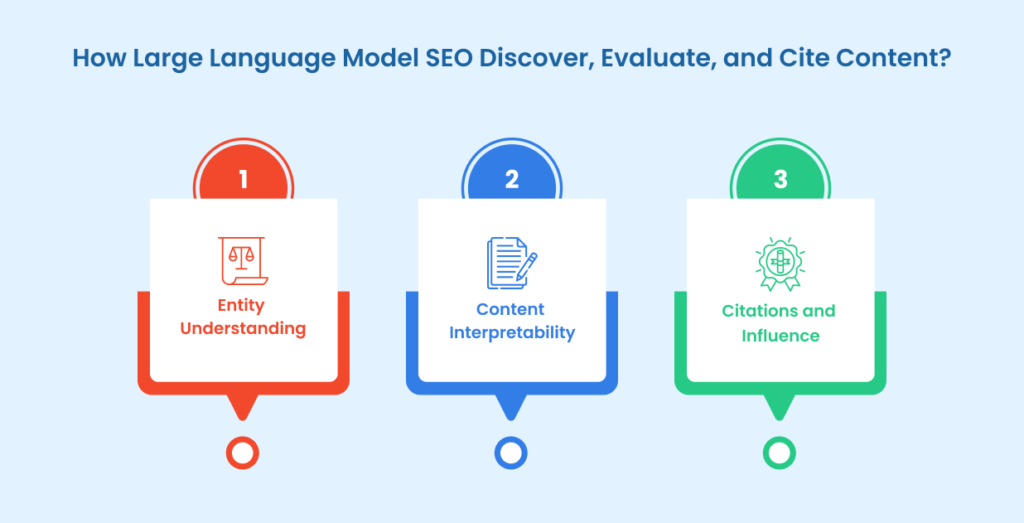
Large language models do not crawl and index content in the same way search engines do. Instead, they rely on a mix of pre-trained knowledge, licensed datasets, and real-time retrieval systems to generate responses.
Entity Understanding: How LLM SEO Recognizes Your Brand
Discovery starts with entity understanding. Large language models require a clear understanding of who you are, what you offer, and how your brand aligns with specific platforms, industries, or use cases.
Consistent naming, clear positioning, and context-rich content enable AI systems to form accurate associations, whereas vague messaging or shallow explanations hinder this understanding.
Content Interpretability: Why Clear Content Gets Used
When AI systems retrieve live content, they prioritize pages that are easy to interpret. Content that explains concepts clearly, avoids unnecessary marketing language, and provides factual depth is more likely to be reused in AI-generated answers.
This is where LLM SEO and LLM marketing align; clarity and structure directly impact whether your content is selected as a reliable source.
Citations and Influence: Why Being Referenced Matters
Citations matter because AI-generated answers often influence platform evaluations, vendor shortlists, integration decisions, and budget approvals. If your content is not cited, it may never enter the consideration set. Being referenced by AI positions your expertise at the moment when users are actively comparing options.
Citations matter because AI-generated answers often influence:
- Platform Evaluations
- Vendor Shortlists
- Integration Decisions
- Budget Approvals
Together, entity clarity, interpretability, and citation-worthiness determine whether content is simply indexed or actually used by AI systems. Without these signals, visibility in AI-powered search remains limited and inconsistent.
E-E-A-T in LLM SEO: How AI Determines Trust and Authority
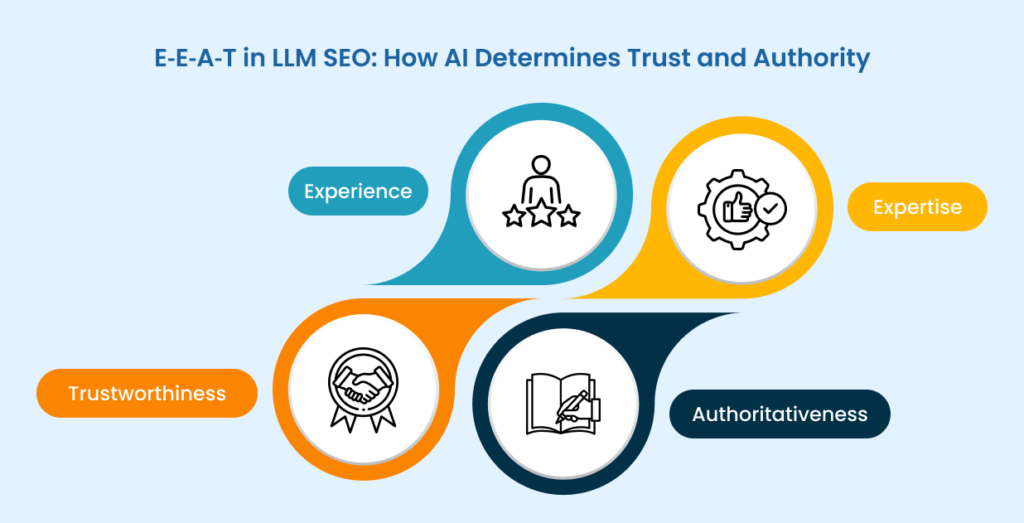
E‑E‑A‑T (Experience, Expertise, Authoritativeness, and Trustworthiness) has taken on new meaning in AI search optimization. In LLM SEO, trust is built through patterns, not one-off signals.
- Experience is demonstrated through real-world insights: implementation challenges, platform tradeoffs, and operational considerations.
- Expertise shows up in technical accuracy, depth, and the ability to explain complex topics clearly.
- Authoritativeness is reinforced by consistent coverage of related topics over time, not isolated blog posts.
- Trustworthiness comes from transparency, factual accuracy, and content that prioritizes education over promotion.
E-E-A-T plays a foundational role in LLM SEO because AI systems rely on trust signals to determine which sources are credible enough to reference in generated answers. Brands that invest in strong E-E-A-T through strategic AI SEO Services are more likely to be recognized, trusted, and reused by AI-driven search experiences.
- Increases the likelihood of content being cited in AI-generated responses
- Strengthens brand credibility across AI search, chat, and discovery platforms
- Helps large language models accurately interpret expertise and topical authority
- Reduces the risk of content being filtered out due to weak trust signals
- Supports long-term visibility as AI systems favor consistently reliable sources
- Reinforces entity-level trust through structured, expert-led AI SEO Services
Technical SEO Changes Required for AI-Driven Search
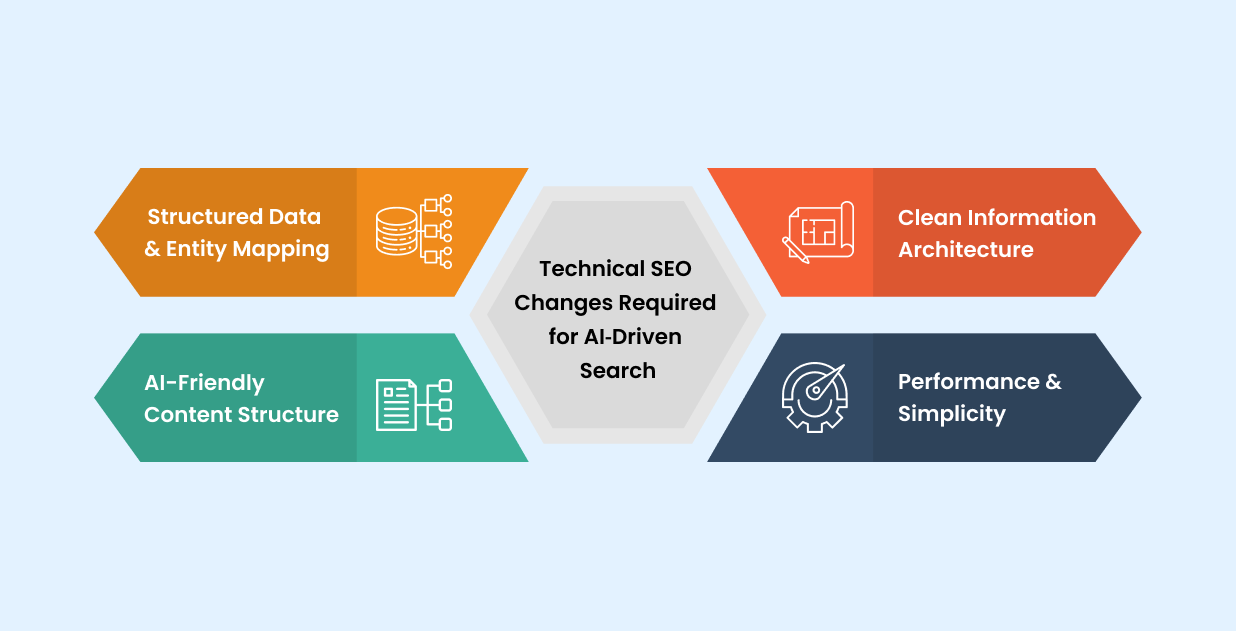
Technical SEO in the age of AI has moved beyond basic crawlability to machine interpretability. AI systems need content that is not only accessible but also structured in a way that allows accurate extraction, reuse, and ranking within AI-generated answers, directly influencing LLM rankings.
To support AI-driven search systems, eCommerce and content teams should focus on the following core areas:
- Structured Data & Entity Mapping: Schema markup helps AI models understand relationships between products, services, brands, and topics, improving contextual accuracy in generated responses.
- Clean Information Architecture: Logical page hierarchies, clear internal linking, and consistent URLs help AI systems navigate and interpret site-wide expertise more efficiently.
- Performance & Simplicity: Fast load times, minimal scripts, and clean HTML reduce friction for AI retrieval systems and improve content reliability.
- AI-Friendly Content Structure: Well-defined headings, concise sections, and direct explanations minimize ambiguity when AI extracts key information, increasing trust and reuse.
When technical SEO is aligned with how AI systems interpret content, brands improve accuracy, visibility, and stability across AI-powered discovery factors that increasingly determine LLM rankings rather than traditional position-based results.
Optimizing for AI Answers Instead of Traditional Rankings
Optimizing for AI answers requires a fundamental shift in approach. The goal is no longer just to earn clicks; it’s to become the most reliable, clearly articulated source that AI systems can reference when generating responses.
What Matters Most When Optimizing for AI Answers:
Align Content with How Questions are Asked
AI systems surface content that mirrors real user questions and delivers direct, well-structured answers without unnecessary marketing language or filler.
Optimize for clarity and interpretability
Concise explanations, logical headings, and focused sections make it easier for AI to extract accurate information and reuse it in generated answers.
Build depth through connected topics
AI favors brands that demonstrate comprehensive coverage across related subjects rather than isolated pages. Interlinking strategy, technical insights, and implementation guidance strengthens contextual understanding.
Understand how this impacts complex buying journeys
In industries with longer evaluation cycles, such as B2B, AI answers increasingly influence early research and vendor discovery. ioVista explores this shift in detail in its guide on how LLM-driven SEO is transforming the B2B industry, highlighting how AI reshapes discovery and trust-building.
Optimize for citation, not position
Being cited within AI-generated responses increases visibility at decision-shaping moments, even when traditional rankings fluctuate.
When content is optimized for AI answers, it extends influence beyond search results and into the AI-driven conversations where real decisions are formed.
Measuring LLM Visibility and AI Search Optimization Impact
Traditional SEO metrics do not fully capture AI-driven visibility. Rankings and traffic still matter, but they reflect only a portion of how users discover and evaluate brands in AI-powered search.
Key signals to track for LLM SEO performance include:
- AI referral traffic from chat-based and generative search experiences
- Brand mentions within AI-generated responses across relevant prompts
- Citation frequency, indicating how often AI systems reference your content
- Assisted conversions, where AI discovery contributes earlier in the journey
- Reduced time-to-decision, signaling higher trust and faster evaluation
LLM SEO success is measured by combining quantitative analytics with qualitative AI testing, ensuring AI visibility translates into meaningful business impact, not just surface-level exposure.
How ioVista Helps eCommerce Brands Win in AI-Powered Search
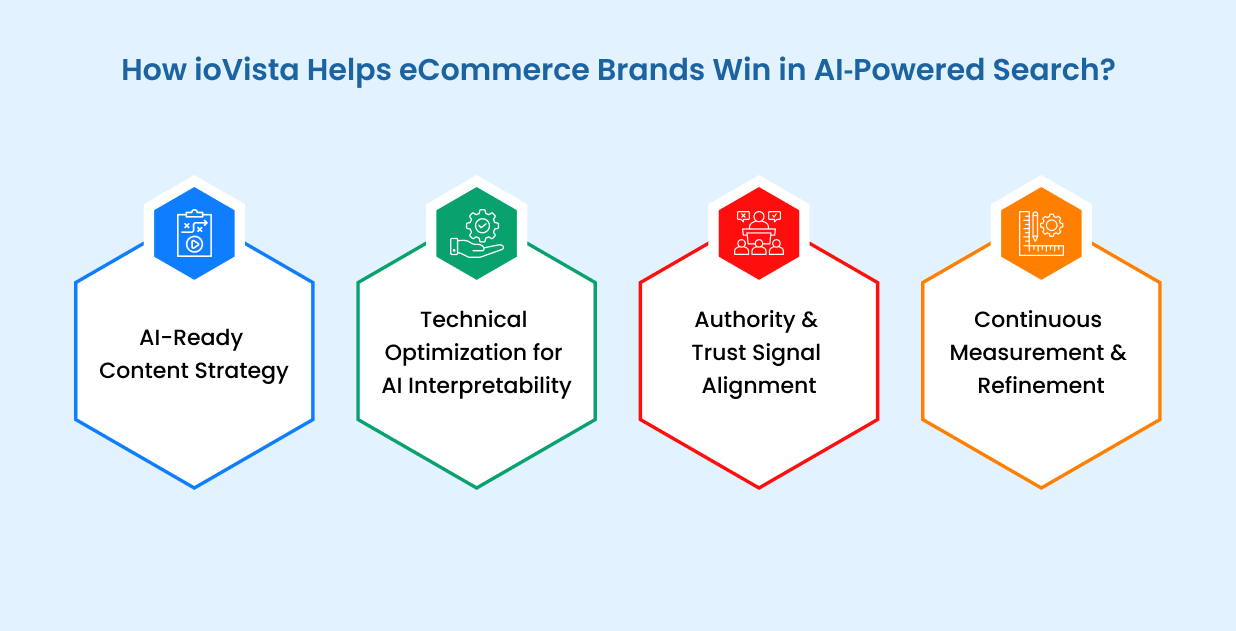
LLM SEO requires a strategic, integrated approach. It is not a checklist or a one-time optimization; it’s an ongoing effort to align how AI systems interpret content, authority, and technical signals across the entire digital ecosystem.
ioVista helps eCommerce brands build long-term visibility and trust in AI-powered search by connecting strategy, content, and technology into a unified AI SEO framework.
AI-Ready Content Strategy
Structuring content around real user questions, clear explanations, and topical depth that AI systems can easily extract, summarize, and cite.
Technical Optimization for AI Interpretability
Improving site architecture, structured data, and performance to ensure content is accessible and reusable by AI-driven retrieval systems.
Authority & Trust Signal Alignment
Strengthening E-E-A-T signals across blogs, service pages, documentation, and thought leadership to reinforce AI trust at scale.
Continuous Measurement & Refinement
Monitoring AI visibility, citations, and referral signals to adapt strategies as search behavior and AI systems evolve.
By focusing on how AI systems actually discover and evaluate information, ioVista helps brands move beyond traditional rankings and establish durable visibility in an AI-first search landscape. Get in touch to build an AI SEO strategy that drives long-term impact.
Frequently Asked Questions (FAQs)
What is LLM optimization?
LLM optimization is the process of structuring content, technical signals, and authority indicators so that large language models can accurately understand, trust, and reuse information when generating AI-driven search answers. Instead of focusing only on rankings, LLM optimization prioritizes clarity, topical depth, and citation-worthiness.
How is LLM SEO different from traditional SEO?
Traditional SEO focuses on keywords, backlinks, and rankings in search engine results pages. LLM SEO goes further by optimizing how AI systems interpret expertise, evaluate credibility, and decide which sources to reference in generated responses.
Why is LLM SEO important for eCommerce brands?
LLM SEO helps eCommerce brands stay visible as search shifts toward AI-generated answers. When AI tools influence product discovery, platform evaluation, and solution comparison, being cited by AI systems becomes critical for maintaining authority and trust.
How can eCommerce brands measure success in AI-powered search?
Success in AI-powered search is measured through AI referral traffic, brand mentions in AI-generated responses, citation frequency, and assisted conversions. These signals provide insight into how often AI systems surface and rely on a brand’s content during discovery and evaluation.
Mike Patel


Mike Patel is the Founder and CEO of ioVista, a leading digital commerce agency specializing in eCommerce solutions. With a strong background in business and technology, Mike Patel has been at the forefront of driving digital transformations for businesses. He has successfully navigated the ever-changing landscape of eCommerce, helping companies leverage the power of online platforms to grow their brand, increase revenues, and optimize their digital presence. Under his leadership, ioVista has become a trusted partner with major technology companies: Adobe/Magento, Google, BigCommerce, Shopify, and Yahoo. He is dedicated to staying ahead of industry trends, adopting cutting-edge technologies, and continuously improving strategies to provide clients with a competitive edge. Mike’s commitment to excellence and client satisfaction is evident in every project ioVista undertakes.
Popular Posts
-
Adobe Commerce
Adobe Commerce APSB26-92: Security Risks, Affected Versions, and Next Steps
Albert Wood
13 Aug 2026 -
-
News
How ShopWare and ioVista are Driving Digital Transformation in the 2A Community!
Aaron Pallares
04 Aug 2026 -
News
Why ioVista Became a Shopware Partner: Building the Future of Digital Commerce Through Innovation and Collaboration
Aaron Pallares
28 Jul 2026 -
Adobe Commerce, Magento, Update
Critical Adobe Commerce Security Update APSB26-73: Key Highlights
Mike Patel
15 Jul 2026 -
AI and ML, Google Updates
Google Marketing Live 2026: Everything You Need to Know about Google's AI Advertising Revolution
Mike Patel
16 Jun 2026 -
Adobe Commerce
Critical Adobe Commerce Security Update APSB26-49: Key Highlights
Mike Patel
15 May 2026 -
Adobe Commerce
Adobe Commerce 2.4.9 is Here: Features, Security, and Platform Enhancements
Mike Patel
15 May 2026 -
-
-
-
AI and ML, AIO, B2B
Machine-Readable B2B: The Hidden Layer that Wins AI Visibility
Mike Patel
14 Apr 2026 -
B2B
AI-Ready Catalogs: Turning Your Product Data into a Recommendation Engine
Mike Patel
09 Apr 2026 -
-
-
AIO, SEO
LLM Optimization: How Large Language Models Discover, Rank, and Cite Content
Mike Patel
26 Mar 2026 -
Migration, SEO
SEO Website Migration Checklist: Guide to Protect Your Rankings & Traffic in 2026
Mike Patel
13 Mar 2026 -
Adobe Commerce, Update
Adobe Commerce Security Update APSB26-05: Everything You Need to Know
Mike Patel
12 Mar 2026 -
AIO, SEO
LLM SEO vs GEO vs SEO: What Actually Matters for eCommerce Brands in 2026
Mike Patel
12 Mar 2026 -
Adobe Commerce
Are You Still on Adobe Commerce 2.4.6? Now is the Time to Upgrade
Mike Patel
24 Feb 2026 -
-
-
-
-
AI and ML, SEO
AI-SEO Is Changing Everything in 2026: 5 Strategies to Rank and Stay Relevant
Mike Patel
10 Dec 2025 -
-
E-Commerce
What SEMA 2025 Revealed: The Digital Transformation Race in the Automotive Aftermarket Industry
Mike Patel
20 Nov 2025 -
Adobe Commerce
Most Exciting Update: Hyvä Theme is Now Open Source and FREE
Paren Sutreja
17 Nov 2025 -
News, Shopify
Breakthrough Update: Managing Product Variants on Shopify Got Easier with 2048 Variants
Mike Patel
11 Nov 2025 -
Adobe Commerce, Update
Critical Adobe Commerce Vulnerability (CVE-2025-54236): What Merchants Need to Know
Mike Patel
27 Oct 2025 -
Adobe Commerce, Update
Adobe Commerce Security Update APSB25-94: What You Need to Know
Mike Patel
15 Oct 2025 -
Shopify
The Quiet Revolution: Why the Shopify x ChatGPT Partnership Changes Everything in eCommerce
Mike Patel
03 Oct 2025 -
Adobe Commerce
Adobe Sensei AI in eCommerce 2025: Transforming Digital Commerce
Mike Patel
19 Sep 2025 -
Adobe Commerce
Critical Adobe Commerce Security Update APSB25-88: Key Highlights
Mike Patel
10 Sep 2025 -
Shopify
Shopify API Deprecations and New Features: A Merchant's Guide to Upcoming Changes
Mike Patel
08 Sep 2025 -
AI and ML
Agentic AI for Business - Drive Success with Intelligent Automation
Mike Patel
27 Aug 2025 -
Adobe Commerce, Update
Adobe Commerce Security Update APSB25-71: Essential Security Fixes You Need to Know
Mike Patel
13 Aug 2025 -
News, Shopify
Shopify Summer Edition 2025: A Technical Insight into the Latest Update
Mike Patel
08 Aug 2025 -
-
Adobe Commerce, Magento
Adobe Commerce Security Update APSB25-50: Key Highlights
Mike Patel
11 Jun 2025 -
Adobe Commerce, B2B, E-Commerce
B2B Excellence Starts with Adobe Commerce (Magento) - Not WooCommerce
Mike Patel
03 Jun 2025 -
AI and ML, B2B, Digital Marketing, E-Commerce, Web Development
AI and ML in B2B: A Vision for the Future of Commerce by 2025
Mike Patel
27 May 2025 -
B2B, Digital Marketing, E-Commerce, Web Development
20 Next-Gen B2B eCommerce Features that will Dominate in 2025
Mike Patel
20 May 2025 -
B2B, BigCommerce, E-Commerce, Web Development
WooCommerce to BigCommerce Migration Fuels Your B2B eCommerce Growth
Mike Patel
06 May 2025 -
Adobe Commerce, E-Commerce, Migration, News, Web Development
Adobe Commerce SaaS: How Will It Empower Your eCommerce Business?
Mike Patel
22 Apr 2025 -
B2B, E-Commerce, Web Development
Leverage ERP Integration to Scale Your B2B eCommerce Business in 2025
Mike Patel
15 Apr 2025 -
Adobe Commerce, E-Commerce, Magento, News, Web Development
Adobe Commerce Security Update APSB25-26: All You Need to Know
Mike Patel
10 Apr 2025 -
Adobe Commerce, E-Commerce, Magento, News, Web Development
Adobe Commerce 2.4.8 Release: Key Highlights
Mike Patel
10 Apr 2025 -
B2B, E-Commerce, Migration, Web Development
Why Scaling Business Should Migrate WooCommerce Stores to Shopify
Mike Patel
08 Apr 2025 -
Adobe Commerce, B2B, E-Commerce, Magento, Web Development
Why Does Adobe Commerce (Magento) Lead the Way of B2B eCommerce
Mike Patel
18 Mar 2025 -
B2B, Digital Marketing, E-Commerce, Web Development
Gain a Competitive Edge by Turning Obstacles into Opportunities: B2B Digital Transformation in 2025
Mike Patel
11 Mar 2025 -
AI and ML, B2B, Digital Marketing, E-Commerce, Web Development
10 Key Drivers of Digital Transformation in B2B eCommerce for 2025
Mike Patel
04 Mar 2025 -
B2B, E-Commerce, Web Development
5 Leading eCommerce Platforms to Build Scalable B2B Customer Portals
Mike Patel
25 Feb 2025 -
Google Updates, News, SEO
Google Search Ranking Volatility: All You Need to Know
Mike Patel
18 Feb 2025 -
Adobe Commerce, E-Commerce, Magento, News, Web Development
Adobe Commerce Security Update APSB25-08: All You Need to Know
Mike Patel
13 Feb 2025 -
B2B, E-Commerce, Web Development
7 Strategic Benefits of an Online B2B Customer Portal
Mike Patel
11 Feb 2025 -
B2B, E-Commerce, Web Development
What Makes a Great Online B2B Customer Portal? Top 10 Features to Know
Mike Patel
04 Feb 2025 -
B2B, E-Commerce, Web Development
Legacy B2B eCommerce Systems Slowing You Down? It's Time for Modernization
Mike Patel
28 Jan 2025 -
B2B, E-Commerce, Manufacturing, Migration, Web Development
80% of B2B Businesses Are Holding You Back by Legacy eCommerce Systems. Is Yours One of Them?
Mike Patel
15 Jan 2025 -
B2B, E-Commerce, Manufacturing, Web Development
Essential B2B Commerce Features for 2024
Mike Patel
20 Nov 2024 -
Adobe Commerce, E-Commerce, Magento, News, Web Development
Security Update Available for Adobe Commerce | APSB24-90
Albert Wood
20 Nov 2024 -
Adobe Commerce, E-Commerce, Magento, News
Why Choose Hyvä Enterprise for Your Adobe Commerce Store?
Paren Sutreja
19 Nov 2024 -
Adobe Commerce, E-Commerce, Magento, News
Security Update APSB24-73 for Adobe Commerce: Everything You Need to Know
Albert Wood
14 Oct 2024 -
Adobe Commerce, E-Commerce, Magento, News, Web Development
CosmicSting Exploit Still Poses a Threat
Albert Wood
25 Jul 2024 -
Adobe Commerce, E-Commerce, Magento, News
CosmicSting: Unauthorized XXE Vulnerability
Albert Wood
17 Jul 2024 -
Adobe Commerce, E-Commerce, Magento, News
Hyvä Theme for Magento 2: Uncover Powerful Features – Evaluate Pros and Cons
Paren Sutreja
16 Jul 2024 -
Adobe Commerce, Magento, News, Web Development
Magento 2.4.7: Explore the Newest Enhancements and Features
Albert Wood
30 Apr 2024 -
Adobe Commerce, Magento, News, Web Development
Magento 2.4.6-p5: Enhancing Stability and Security
Mike Patel
22 Apr 2024 -
-
Digital Marketing, E-Commerce, SEO
The Impact of Site Speed on eCommerce SEO Performance
Mike Patel
14 Feb 2024 -
Awards & Recognition, B2B, BigCommerce, E-Commerce, Manufacturing, Web Development
ioVista Attains B2B Specialization on BigCommerce
Albert Wood
30 Oct 2023 -
Adobe Commerce, BigCommerce, Digital Marketing, E-Commerce, Magento, SEO
5 Ways to Boost eCommerce Sales in 2024
Mike Patel
21 Sep 2023 -
Adobe Commerce, Awards & Recognition, B2B, E-Commerce, Magento, Manufacturing, Web Development
It’s Official: ioVista Has Become a Recognized Adobe Specialized Partner
Albert Wood
05 Sep 2023 -
Adobe Commerce, E-Commerce, Magento, News, Web Development
Magento 2.4.7-beta1 Release
Mike Patel
15 Aug 2023 -
-
Awards & Recognition, B2B, E-Commerce, Manufacturing, Web Development
ioVista Announced as a 2023 Local Excellence Award Winner by UpCity
Albert Wood
09 May 2023 -
Digital Marketing, E-Commerce, News
Google Analytics 4: What You Need To Know
Albert Wood
29 Mar 2023 -
Adobe Commerce, E-Commerce, Magento, News, Web Development
Adobe Commerce 2.4.6 Release
Mike Patel
13 Mar 2023 -
Adobe Commerce, E-Commerce, Magento, Web Development
Questions You Should Ask Your Magento Agency
Albert Wood
17 Feb 2023 -
B2B, Digital Marketing, E-Commerce, Manufacturing, Web Development
7 Proven Strategies to Increase B2B/Wholesale eCommerce Revenue
Mike Patel
01 Feb 2023 -
Digital Marketing, E-Commerce
10 eCommerce Trends to Increase your Sales in 2023
Albert Wood
12 Jan 2023 -
B2B, E-Commerce, Manufacturing, Web Development
B2B eCommerce Features Your Store Need in 2023
Albert Wood
05 Jan 2023 -
Adobe Commerce, E-Commerce, Magento, News, Web Development
Adobe/Magento Highlights 2022 - Is your store Up-to-Date
Mike Patel
20 Dec 2022 -
BigCommerce, E-Commerce, News, Web Development
BigCommerce Releases StagingPro for Enterprise Merchants and Agency Developers
Albert Wood
15 Dec 2022 -
Adobe Commerce, E-Commerce, Magento, News, Web Development
Adobe discontinues Support for the 2.4.0-2.4.3 Release Line
Mike Patel
09 Dec 2022 -
-
Digital Marketing, E-Commerce, News
Universal Analytics Going Away: What Does it Mean, What you need to Do?
Albert Wood
24 Nov 2022 -
Adobe Commerce, E-Commerce, Magento, News
40% of Magento and Adobe Commerce Websites at Risk in November 2022
Albert Wood
17 Nov 2022 -
E-Commerce, Web Development
Website Support: How Can ioVista Help keep your Store Up and Running During Holidays
Mike Patel
17 Nov 2022 -
Awards & Recognition, B2B, E-Commerce, Manufacturing, News
ioVista Awarded the Best B2B Company 2022
Albert Wood
04 Nov 2022 -
Adobe Commerce, Magento, News
Adobe Releases Critical Security Patches for Magento 2.4.5 and 2.4.4
Albert Wood
27 Oct 2022 -
-
E-Commerce, News
ioVista is Sponsoring the Largest eCommerce Event in Dallas
Albert Wood
07 Oct 2022 -
Adobe Commerce, E-Commerce, Magento, News
Magento 2 Vulnerability: Surge in Hacking on Unpatched Stores
Mike Patel
27 Sep 2022 -
B2B, Digital Marketing, E-Commerce
Get your Holiday eCommerce Marketing Started with These 5 Tips
Albert Wood
15 Sep 2022 -
Adobe Commerce, B2B, E-Commerce, Magento
Why a Magento Code Audit is Essential for your eCommerce Store
Mike Patel
10 Sep 2022 -
-
-
B2B, BigCommerce, E-Commerce
How BigCommerce makes it easy for Legacy Businesses to get started with B2B eCommerce
Mike Patel
23 Aug 2022 -
B2B, E-Commerce, Manufacturing
The Challenges of eCommerce in Manufacturing and How to Overcome Them
Mike Patel
17 Aug 2022


























Let’s work together to create outstanding digital experiences.
With 20+ years of industry experience, ioVista understands your eCommerce needs and delivers best-in-class solutions that help you gain a competitive edge.
or Call us at: +1 214-699-4391

TOP
Get in Touch