


E-E-A-T for LLMs: Signals That Shape AI Trust and Rankings
27 Mar 2026
 Mike Patel


AI-powered search is no longer experimental. It now plays a vital role in how people research, compare, and select solutions, vendors, products, and more. Instead of just showing links, AI systems interpret information, summarize insights, and recommend sources they consider reliable. In this environment, E-E-A-T for LLMs helps identify which content AI models trust and reference.
Large Language Models (LLMs) don’t follow traditional SEO rules. They analyze information across different sources, compare explanations, and look for consistent and accurate patterns. Experience, expertise, authority, and trust are assessed together through repeated signals that shape which content AI systems rely on when generating answers.
In this post, you will learn how LLMs interpret E-E-A-T, the specific signals that strengthen or weaken trust in AI, and how eCommerce brands can build a long-term strategy to support sustainable visibility in AI-driven search environments.
How E-E-A-T for LLMs Shapes Long-Term AI Trust Signals?
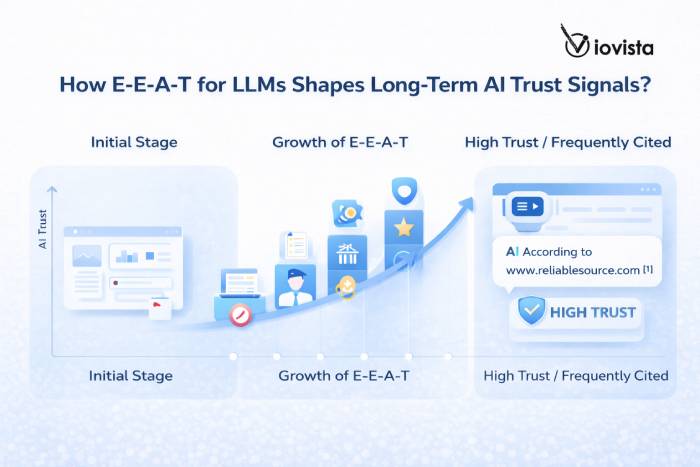
As AI-powered search becomes a primary discovery channel, understanding how LLMs evaluate credibility is critical.
Unlike traditional algorithms that rely on fixed ranking signals, LLMs learn trust by observing patterns, comparing sources, and reinforcing reliability. They don’t simply retrieve information. They decide which sources are dependable enough to reuse when generating answers.
Trust Is Pattern-Based, Not Rule-Based
Large Language Models build trust by observing repeated behavior across large datasets rather than following predefined evaluation rules. Trust emerges when information patterns remain stable and reliable over time.
Key factors that reinforce pattern-based trust:
- Repeated alignment of explanations across multiple independent sources
- Consistent use of accurate terminology and framing
- Stable interpretations that do not contradict established knowledge
When these patterns persist, LLMs gain confidence that the information is dependable. Trust, in this context, is cumulative and strengthens as consistency increases.
E-E-A-T Is Shown, Not Stated
LLMs do not evaluate credibility based on self-reported claims or labels. Statements of authority, expertise, or experience only matter when supported by how information is presented.
When considering E-E-A-T in AI search, credibility is inferred from the substance of the content rather than what the content claims about itself.
LLMs assess credibility by examining:
- Clarity and logic of explanations
- Accuracy of assumptions and conclusions
- Whether the content demonstrates understanding rather than promotion
Experience and expertise must be embedded directly into the explanation itself. Content that demonstrates knowledge earns trust, while content that merely asserts it, does not.
Depth and Specificity Signal Expertise
Depth plays a central role in how LLMs identify expertise. Broad summaries may be readable, but they rarely provide enough information for AI systems to assign high confidence.
Indicators of depth and specificity include:
- Detailed breakdowns of processes or concepts
- Context-aware explanations that go beyond definitions
- Inclusion of limitations, trade-offs, or real-world conditions
Depth acts as a validation signal in how AI systems evaluate experience, expertise, authority, and trust. Specific explanations reduce ambiguity for LLMs and make it easier to assess accuracy and context.
For eCommerce brands that look to strengthen AI trust, a structured content approach that builds depth over time is essential. Effective AI SEO strategies help you create and optimize content that aligns with AI evaluation signals while maintaining real-world relevance and clarity.
Consistency Builds Authority
Authority is gained over time through repeated exposure to aligned information. LLMs evaluate whether content maintains a stable point of view across different contexts.
Signals that contribute to authority:
- Consistent terminology and conceptual framing
- Alignment between related pieces of content
- Absence of conflicting or contradictory explanations
When information remains consistent, AI systems are more likely to associate that source with subject ownership and long-term reliability.
Accuracy and Transparency Reinforce Trust
Accuracy forms the foundation of AI trust. Even well-structured content loses credibility if factual errors or unclear ownership are present. From an E-E-A-T in AI perspective, accuracy and transparency help LLMs reduce uncertainty and assess whether information is reliable enough to reuse.
LLMs favor content that demonstrates:
- Factually correct and verifiable information
- Internal consistency without logical contradictions
- Transparent attribution and responsible presentation
Accuracy and transparency reduce uncertainty, allowing LLMs to treat the content as a dependable reference rather than a questionable source.
The Role of E-E-A-T for LLMs in AI Trust Formation
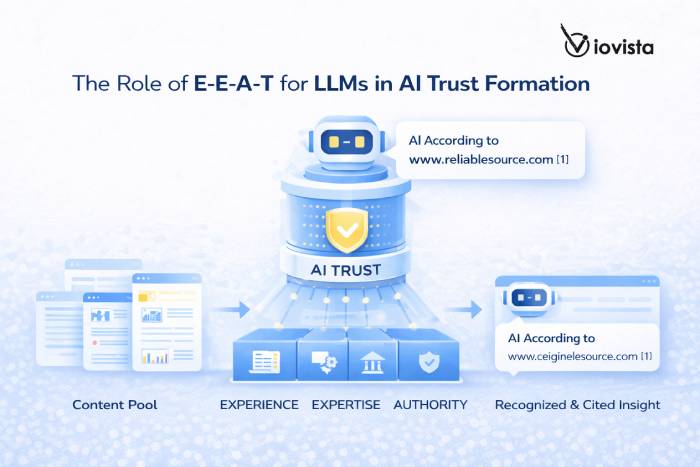
For Large Language Models, trust is not assigned instantly or based on isolated signals. It is formed through repeated exposure to content that demonstrates experience, expertise, authority, and trustworthiness in measurable ways.
With E-E-A-T in AI search, these signals help AI systems determine which sources are reliable enough to reference, summarize, or reuse when generating answers.
Experience Signals LLMs Recognize
Experience is inferred from how closely content reflects real-world understanding. LLMs look for signals that suggest knowledge comes from practical engagement rather than abstraction.
Common experience indicators include:
- Explanations grounded in real scenarios rather than theory alone
- Awareness of edge cases, constraints, or contextual variations
- Language that reflects applied understanding, not just definitions
When content reflects how concepts behave in practice, LLMs are more likely to associate it with firsthand knowledge. This reduces uncertainty and increases confidence in the reliability of the information.
E – Expertise Signals That Prove Domain Mastery
Expertise is identified through depth, precision, and conceptual clarity. LLMs assess whether content demonstrates a strong command of the subject rather than surface-level familiarity.
Signals of expertise include:
- Accurate use of terminology and concepts
- Clear explanation of cause-and-effect relationships
- Logical structure that builds understanding progressively
Expertise becomes evident when content can explain not just what something is, but why it works the way it does. This level of clarity helps LLMs differentiate authoritative explanations from generic summaries.
A – Authority Signals That Strengthen Credibility
Authority emerges when content consistently aligns with trusted information patterns. LLMs provide authority by observing whether a brand or source repeatedly reinforces accurate interpretations without contradiction.
Authority signals include:
- Consistency across related content and topics
- Alignment with widely accepted frameworks or principles
- Absence of conflicting explanations
This is why broader content strategies empower LLM-driven SEO and transform B2B & B2C domains. They show how strategic alignment and content maturity contribute to authority that AI systems recognize and trust.
When content repeatedly reinforces accurate interpretations, LLMs begin to associate it with subject ownership, making it more likely to be treated as a dependable reference.
T – Trust Signals That Increase Reliability
Trust ties all E-E-A-T components together. Even experienced and expert content can lose credibility if accuracy or transparency is lacking.
LLMs favor content that shows:
- Verifiable and factually accurate information
- Internal consistency and logical coherence
- Clear intent, free from misleading or exaggerated claims
By considering E-E-A-T in AI, you can deliver trust signals that reduce risk for AI systems. When information is accurate, transparent, and responsibly presented, LLMs are more willing to reuse it in AI-generated answers.
E-E-A-T Signals That Reduce AI Trust (What to Avoid)

Not all content signals build credibility in AI systems. Certain patterns actively weaken trust and reduce the likelihood that LLMs will reuse or reference information in generated answers. Understanding what undermines trust is just as important as knowing what strengthens it.
Generic, Templated, or AI-Only Content
Content that follows repetitive formats or relies on generic language fails to demonstrate originality or depth. LLMs compare information across many sources and quickly recognize templated structures.
When explanations lack nuance, context, or unique insight, the content becomes interchangeable with thousands of similar pages. This reduces confidence and makes AI systems less likely to treat it as a reliable or reusable source.
Unsupported Authority Claims
Simply stating expertise does not establish credibility. In E-E-A-T for LLMs, authority must emerge from explanation quality, logical structure, and factual grounding. Claims without supporting detail raise skepticism. Repeated unsupported assertions weaken how AI systems perceive the reliability of the source.
Inconsistency Across Channels and Pages
LLMs evaluate information holistically, comparing explanations across related content. Inconsistent terminology, shifting definitions, or contradictory statements introduce uncertainty.
Even subtle variations can disrupt trust when AI systems attempt to form stable associations. When content fails to reinforce the same core ideas, LLMs struggle to determine which interpretation is accurate and reliable.
Outdated or Unmaintained Content
Content that reflects obsolete assumptions or lacks updates, AI systems do not consider them. AI systems favor information that aligns with current understanding and evolving contexts.
Outdated examples, unchanged references, or stale explanations increase the risk of inaccuracies. When content appears unmaintained, LLMs hesitate to reuse it because they cannot be confident that the information is still accurate or relevant.
Content that consistently receives these negative signals becomes less reliable in the eyes of AI systems. Avoiding these pitfalls is essential for maintaining long-term visibility and trust in AI-powered search environments.
Building a Long-Term E-E-A-T Strategy for LLM Rankings
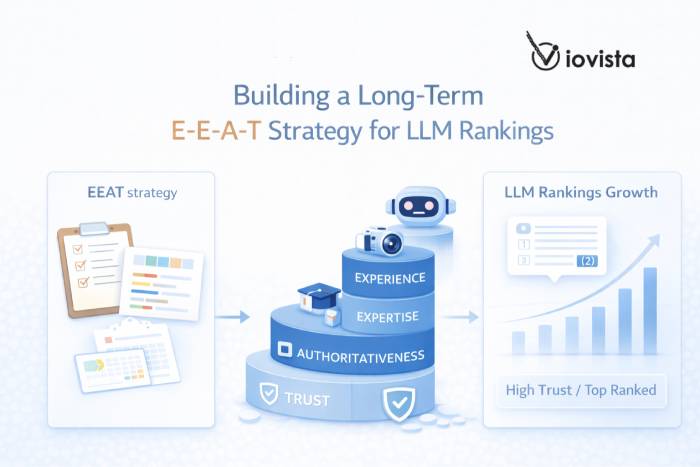
Earning visibility in AI-driven search is not a one-time optimization effort. LLMs evaluate credibility over time by observing consistency, depth, and reliability across content ecosystems.
A long-term approach ensures that trust signals compound rather than reset, allowing AI systems to recognize and retain confidence in your content as they continuously learn and adapt.
Reinforce E-E-A-T Consistently
Consistency is foundational to E-E-A-T for LLMs. Repeated reinforcement of accurate explanations, aligned terminology, and stable perspectives helps AI systems identify dependable patterns.
When content repeatedly demonstrates the same level of quality and understanding, LLMs gain confidence in its reliability. Inconsistent quality or messaging weakens trust, while consistent reinforcement strengthens long-term recognition and reuse.
Increase Content Maturity
Content maturity reflects how knowledge evolves over time. Using E-E-A-T in AI search, LLMs favor content that deepens, expands, and refines explanations rather than remaining static. Mature content incorporates updated insights, refined clarity, and broader contextual understanding.
This progression signals active stewardship and reduces uncertainty, making AI systems more willing to treat the information as current, relevant, and dependable.
Align E-E-A-T With Buyer Journeys
Effective trust-building mirrors how people seek information, starting broad and becoming more specific. Mapping E-E-A-T signals to different stages of discovery helps ensure relevance at each step.
Early-stage content builds clarity and understanding, while deeper material demonstrates experience and authority. This alignment helps LLMs contextualize information correctly and associate it with real-world decision-making behavior.
Proven Expertise to Build Trust
Trust increases when expertise is demonstrated through detailed, context-aware explanations. To improve E-E-A-T for LLMs, expertise is shown by accurately addressing workflows, limitations, integrations, and edge cases.
Content that reflects hands-on familiarity reduces ambiguity for AI systems. The clearer and more specific the knowledge, the easier it is for LLMs to validate and reuse confidently.
A sustainable E-E-A-T strategy is built through repetition, refinement, and relevance. When trust signals are reinforced consistently over time, LLMs are far more likely to recognize, retain, and reference your content in AI-powered search experiences.
What Sets ioVista Apart in Building AI Search Trust?
ioVista’s approach to building AI-trusted authority is rooted in delivering content and digital strategies that align with how AI systems evaluate trust, credibility, and relevance.
Through specialized AI SEO services, ioVista focuses on strengthening E-E-A-T signals by combining deep technical knowledge, structured content, and real-world implementation expertise.
Every strategy is designed to help eCommerce brands earn sustained visibility across AI-powered search experiences by being consistently accurate, authoritative, and reference-worthy.
If you’re looking to build long-term trust with AI systems and future-proof your search presence, get in touch with our AI SEO experts to explore how our AI-driven SEO approach can support your growth.
Frequently Asked Questions (FAQs)
What does E-E-A-T for LLMs mean in AI-powered search?
E-E-A-T for LLMs refers to how Large Language Models infer experience, expertise, authority, and trust from content patterns rather than direct labels. AI systems evaluate depth, consistency, accuracy, and real-world relevance to determine which sources are reliable enough to summarize, reuse, or cite in AI-generated answers.
How is E-E-A-T for LLMs different from traditional SEO E-E-A-T?
Traditional SEO applies E-E-A-T as a ranking guideline, while LLMs treat it as a learned trust signal. Instead of checking metadata or declared credentials, LLMs analyze explanation quality, cross-source consistency, and historical reliability to decide whether content is safe and trustworthy to include in AI responses.
What content signals most influence AI trust and rankings?
AI trust is influenced by content depth, specificity, factual accuracy, and long-term consistency. LLMs favor explanations that demonstrate real understanding, acknowledge limitations, and align with established knowledge patterns. Content that evolves and avoids contradictions is more likely to earn repeat visibility in AI search results.
How can brands improve E-E-A-T signals for AI rankings?
Brands can strengthen E-E-A-T for LLMs by focusing on clarity over promotion, updating content regularly, maintaining consistent messaging, and demonstrating real-world expertise through detailed explanations. A long-term AI SEO strategy helps reinforce trust signals that compound over time as AI systems continue learning.
Mike Patel

Mike Patel is the Founder and CEO of ioVista, a leading digital commerce agency specializing in eCommerce solutions. With a strong background in business and technology, Mike Patel has been at the forefront of driving digital transformations for businesses. He has successfully navigated the ever-changing landscape of eCommerce, helping companies leverage the power of online platforms to grow their brand, increase revenues, and optimize their digital presence. Under his leadership, ioVista has become a trusted partner with major technology companies: Adobe/Magento, Google, BigCommerce, Shopify, and Yahoo. He is dedicated to staying ahead of industry trends, adopting cutting-edge technologies, and continuously improving strategies to provide clients with a competitive edge. Mike’s commitment to excellence and client satisfaction is evident in every project ioVista undertakes.
Popular Posts
-
Adobe Commerce
Adobe Commerce APSB26-92: Security Risks, Affected Versions, and Next Steps
Albert Wood
13 Aug 2026 -
-
News
How ShopWare and ioVista are Driving Digital Transformation in the 2A Community!
Aaron Pallares
04 Aug 2026 -
News
Why ioVista Became a Shopware Partner: Building the Future of Digital Commerce Through Innovation and Collaboration
Aaron Pallares
28 Jul 2026 -
Adobe Commerce, Magento, Update
Critical Adobe Commerce Security Update APSB26-73: Key Highlights
Mike Patel
15 Jul 2026 -
AI and ML, Google Updates
Google Marketing Live 2026: Everything You Need to Know about Google's AI Advertising Revolution
Mike Patel
16 Jun 2026 -
Adobe Commerce
Critical Adobe Commerce Security Update APSB26-49: Key Highlights
Mike Patel
15 May 2026 -
Adobe Commerce
Adobe Commerce 2.4.9 is Here: Features, Security, and Platform Enhancements
Mike Patel
15 May 2026 -
-
-
-
AI and ML, AIO, B2B
Machine-Readable B2B: The Hidden Layer that Wins AI Visibility
Mike Patel
14 Apr 2026 -
B2B
AI-Ready Catalogs: Turning Your Product Data into a Recommendation Engine
Mike Patel
09 Apr 2026 -
-
-
AIO, SEO
LLM Optimization: How Large Language Models Discover, Rank, and Cite Content
Mike Patel
26 Mar 2026 -
Migration, SEO
SEO Website Migration Checklist: Guide to Protect Your Rankings & Traffic in 2026
Mike Patel
13 Mar 2026 -
Adobe Commerce, Update
Adobe Commerce Security Update APSB26-05: Everything You Need to Know
Mike Patel
12 Mar 2026 -
AIO, SEO
LLM SEO vs GEO vs SEO: What Actually Matters for eCommerce Brands in 2026
Mike Patel
12 Mar 2026 -
Adobe Commerce
Are You Still on Adobe Commerce 2.4.6? Now is the Time to Upgrade
Mike Patel
24 Feb 2026 -
-
-
-
-
AI and ML, SEO
AI-SEO Is Changing Everything in 2026: 5 Strategies to Rank and Stay Relevant
Mike Patel
10 Dec 2025 -
-
E-Commerce
What SEMA 2025 Revealed: The Digital Transformation Race in the Automotive Aftermarket Industry
Mike Patel
20 Nov 2025 -
Adobe Commerce
Most Exciting Update: Hyvä Theme is Now Open Source and FREE
Paren Sutreja
17 Nov 2025 -
News, Shopify
Breakthrough Update: Managing Product Variants on Shopify Got Easier with 2048 Variants
Mike Patel
11 Nov 2025 -
Adobe Commerce, Update
Critical Adobe Commerce Vulnerability (CVE-2025-54236): What Merchants Need to Know
Mike Patel
27 Oct 2025 -
Adobe Commerce, Update
Adobe Commerce Security Update APSB25-94: What You Need to Know
Mike Patel
15 Oct 2025 -
Shopify
The Quiet Revolution: Why the Shopify x ChatGPT Partnership Changes Everything in eCommerce
Mike Patel
03 Oct 2025 -
Adobe Commerce
Adobe Sensei AI in eCommerce 2025: Transforming Digital Commerce
Mike Patel
19 Sep 2025 -
Adobe Commerce
Critical Adobe Commerce Security Update APSB25-88: Key Highlights
Mike Patel
10 Sep 2025 -
Shopify
Shopify API Deprecations and New Features: A Merchant's Guide to Upcoming Changes
Mike Patel
08 Sep 2025 -
AI and ML
Agentic AI for Business - Drive Success with Intelligent Automation
Mike Patel
27 Aug 2025 -
Adobe Commerce, Update
Adobe Commerce Security Update APSB25-71: Essential Security Fixes You Need to Know
Mike Patel
13 Aug 2025 -
News, Shopify
Shopify Summer Edition 2025: A Technical Insight into the Latest Update
Mike Patel
08 Aug 2025 -
-
Adobe Commerce, Magento
Adobe Commerce Security Update APSB25-50: Key Highlights
Mike Patel
11 Jun 2025 -
Adobe Commerce, B2B, E-Commerce
B2B Excellence Starts with Adobe Commerce (Magento) - Not WooCommerce
Mike Patel
03 Jun 2025 -
AI and ML, B2B, Digital Marketing, E-Commerce, Web Development
AI and ML in B2B: A Vision for the Future of Commerce by 2025
Mike Patel
27 May 2025 -
B2B, Digital Marketing, E-Commerce, Web Development
20 Next-Gen B2B eCommerce Features that will Dominate in 2025
Mike Patel
20 May 2025 -
B2B, BigCommerce, E-Commerce, Web Development
WooCommerce to BigCommerce Migration Fuels Your B2B eCommerce Growth
Mike Patel
06 May 2025 -
Adobe Commerce, E-Commerce, Migration, News, Web Development
Adobe Commerce SaaS: How Will It Empower Your eCommerce Business?
Mike Patel
22 Apr 2025 -
B2B, E-Commerce, Web Development
Leverage ERP Integration to Scale Your B2B eCommerce Business in 2025
Mike Patel
15 Apr 2025 -
Adobe Commerce, E-Commerce, Magento, News, Web Development
Adobe Commerce Security Update APSB25-26: All You Need to Know
Mike Patel
10 Apr 2025 -
Adobe Commerce, E-Commerce, Magento, News, Web Development
Adobe Commerce 2.4.8 Release: Key Highlights
Mike Patel
10 Apr 2025 -
B2B, E-Commerce, Migration, Web Development
Why Scaling Business Should Migrate WooCommerce Stores to Shopify
Mike Patel
08 Apr 2025 -
Adobe Commerce, B2B, E-Commerce, Magento, Web Development
Why Does Adobe Commerce (Magento) Lead the Way of B2B eCommerce
Mike Patel
18 Mar 2025 -
B2B, Digital Marketing, E-Commerce, Web Development
Gain a Competitive Edge by Turning Obstacles into Opportunities: B2B Digital Transformation in 2025
Mike Patel
11 Mar 2025 -
AI and ML, B2B, Digital Marketing, E-Commerce, Web Development
10 Key Drivers of Digital Transformation in B2B eCommerce for 2025
Mike Patel
04 Mar 2025 -
B2B, E-Commerce, Web Development
5 Leading eCommerce Platforms to Build Scalable B2B Customer Portals
Mike Patel
25 Feb 2025 -
Google Updates, News, SEO
Google Search Ranking Volatility: All You Need to Know
Mike Patel
18 Feb 2025 -
Adobe Commerce, E-Commerce, Magento, News, Web Development
Adobe Commerce Security Update APSB25-08: All You Need to Know
Mike Patel
13 Feb 2025 -
B2B, E-Commerce, Web Development
7 Strategic Benefits of an Online B2B Customer Portal
Mike Patel
11 Feb 2025 -
B2B, E-Commerce, Web Development
What Makes a Great Online B2B Customer Portal? Top 10 Features to Know
Mike Patel
04 Feb 2025 -
B2B, E-Commerce, Web Development
Legacy B2B eCommerce Systems Slowing You Down? It's Time for Modernization
Mike Patel
28 Jan 2025 -
B2B, E-Commerce, Manufacturing, Migration, Web Development
80% of B2B Businesses Are Holding You Back by Legacy eCommerce Systems. Is Yours One of Them?
Mike Patel
15 Jan 2025 -
B2B, E-Commerce, Manufacturing, Web Development
Essential B2B Commerce Features for 2024
Mike Patel
20 Nov 2024 -
Adobe Commerce, E-Commerce, Magento, News, Web Development
Security Update Available for Adobe Commerce | APSB24-90
Albert Wood
20 Nov 2024 -
Adobe Commerce, E-Commerce, Magento, News
Why Choose Hyvä Enterprise for Your Adobe Commerce Store?
Paren Sutreja
19 Nov 2024 -
Adobe Commerce, E-Commerce, Magento, News
Security Update APSB24-73 for Adobe Commerce: Everything You Need to Know
Albert Wood
14 Oct 2024 -
Adobe Commerce, E-Commerce, Magento, News, Web Development
CosmicSting Exploit Still Poses a Threat
Albert Wood
25 Jul 2024 -
Adobe Commerce, E-Commerce, Magento, News
CosmicSting: Unauthorized XXE Vulnerability
Albert Wood
17 Jul 2024 -
Adobe Commerce, E-Commerce, Magento, News
Hyvä Theme for Magento 2: Uncover Powerful Features – Evaluate Pros and Cons
Paren Sutreja
16 Jul 2024 -
Adobe Commerce, Magento, News, Web Development
Magento 2.4.7: Explore the Newest Enhancements and Features
Albert Wood
30 Apr 2024 -
Adobe Commerce, Magento, News, Web Development
Magento 2.4.6-p5: Enhancing Stability and Security
Mike Patel
22 Apr 2024 -
-
Digital Marketing, E-Commerce, SEO
The Impact of Site Speed on eCommerce SEO Performance
Mike Patel
14 Feb 2024 -
Awards & Recognition, B2B, BigCommerce, E-Commerce, Manufacturing, Web Development
ioVista Attains B2B Specialization on BigCommerce
Albert Wood
30 Oct 2023 -
Adobe Commerce, BigCommerce, Digital Marketing, E-Commerce, Magento, SEO
5 Ways to Boost eCommerce Sales in 2024
Mike Patel
21 Sep 2023 -
Adobe Commerce, Awards & Recognition, B2B, E-Commerce, Magento, Manufacturing, Web Development
It’s Official: ioVista Has Become a Recognized Adobe Specialized Partner
Albert Wood
05 Sep 2023 -
Adobe Commerce, E-Commerce, Magento, News, Web Development
Magento 2.4.7-beta1 Release
Mike Patel
15 Aug 2023 -
-
Awards & Recognition, B2B, E-Commerce, Manufacturing, Web Development
ioVista Announced as a 2023 Local Excellence Award Winner by UpCity
Albert Wood
09 May 2023 -
Digital Marketing, E-Commerce, News
Google Analytics 4: What You Need To Know
Albert Wood
29 Mar 2023 -
Adobe Commerce, E-Commerce, Magento, News, Web Development
Adobe Commerce 2.4.6 Release
Mike Patel
13 Mar 2023 -
Adobe Commerce, E-Commerce, Magento, Web Development
Questions You Should Ask Your Magento Agency
Albert Wood
17 Feb 2023 -
B2B, Digital Marketing, E-Commerce, Manufacturing, Web Development
7 Proven Strategies to Increase B2B/Wholesale eCommerce Revenue
Mike Patel
01 Feb 2023 -
Digital Marketing, E-Commerce
10 eCommerce Trends to Increase your Sales in 2023
Albert Wood
12 Jan 2023 -
B2B, E-Commerce, Manufacturing, Web Development
B2B eCommerce Features Your Store Need in 2023
Albert Wood
05 Jan 2023 -
Adobe Commerce, E-Commerce, Magento, News, Web Development
Adobe/Magento Highlights 2022 - Is your store Up-to-Date
Mike Patel
20 Dec 2022 -
BigCommerce, E-Commerce, News, Web Development
BigCommerce Releases StagingPro for Enterprise Merchants and Agency Developers
Albert Wood
15 Dec 2022 -
Adobe Commerce, E-Commerce, Magento, News, Web Development
Adobe discontinues Support for the 2.4.0-2.4.3 Release Line
Mike Patel
09 Dec 2022 -
-
Digital Marketing, E-Commerce, News
Universal Analytics Going Away: What Does it Mean, What you need to Do?
Albert Wood
24 Nov 2022 -
Adobe Commerce, E-Commerce, Magento, News
40% of Magento and Adobe Commerce Websites at Risk in November 2022
Albert Wood
17 Nov 2022 -
E-Commerce, Web Development
Website Support: How Can ioVista Help keep your Store Up and Running During Holidays
Mike Patel
17 Nov 2022 -
Awards & Recognition, B2B, E-Commerce, Manufacturing, News
ioVista Awarded the Best B2B Company 2022
Albert Wood
04 Nov 2022 -
Adobe Commerce, Magento, News
Adobe Releases Critical Security Patches for Magento 2.4.5 and 2.4.4
Albert Wood
27 Oct 2022 -
-
E-Commerce, News
ioVista is Sponsoring the Largest eCommerce Event in Dallas
Albert Wood
07 Oct 2022 -
Adobe Commerce, E-Commerce, Magento, News
Magento 2 Vulnerability: Surge in Hacking on Unpatched Stores
Mike Patel
27 Sep 2022 -
B2B, Digital Marketing, E-Commerce
Get your Holiday eCommerce Marketing Started with These 5 Tips
Albert Wood
15 Sep 2022 -
Adobe Commerce, B2B, E-Commerce, Magento
Why a Magento Code Audit is Essential for your eCommerce Store
Mike Patel
10 Sep 2022 -
-
-
B2B, BigCommerce, E-Commerce
How BigCommerce makes it easy for Legacy Businesses to get started with B2B eCommerce
Mike Patel
23 Aug 2022 -
B2B, E-Commerce, Manufacturing
The Challenges of eCommerce in Manufacturing and How to Overcome Them
Mike Patel
17 Aug 2022






























Let’s work together to create outstanding digital experiences.
With 20+ years of industry experience, ioVista understands your eCommerce needs and delivers best-in-class solutions that help you gain a competitive edge.
or Call us at: +1 214-699-4391

TOP
Get in Touch