


LLM SEO vs GEO vs SEO: What Actually Matters for eCommerce Brands in 2026
12 Mar 2026
 Mike Patel

Search is no longer a single channel. In 2026, eCommerce discovery happens across search engines, AI chat interfaces, marketplaces, and recommendation systems. This shift is redefining how eCommerce digital marketing services must operate to stay effective.
According to research, 50% of consumers use AI-powered search today, and it stands to impact $650 billion in revenue by 2028. It means visibility is no longer determined only by rankings, but by whether AI systems can understand, trust, and surface your brand.
For modern eCommerce brands, a future-ready eCommerce SEO strategy must account for traditional search engines, generative AI tools, and emerging discovery platforms simultaneously.
Large Language Model (LLM) SEO: Optimizing for AI Understanding
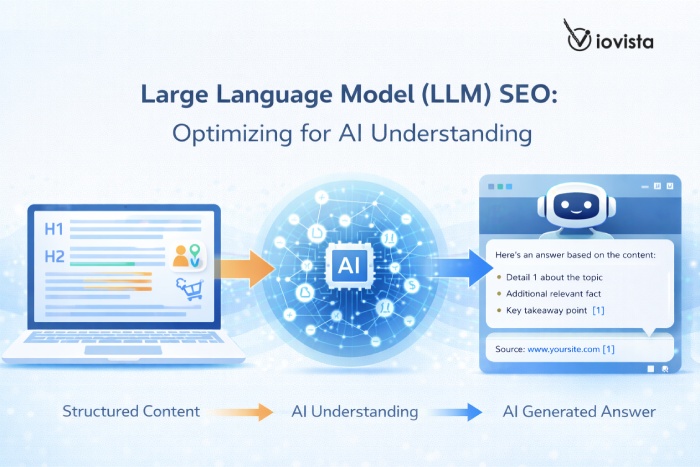
LLM SEO is no longer an experimental concept. In 2026, it is a core pillar of AI SEO for eCommerce, especially as buyers increasingly rely on AI tools to research platforms, compare solutions, and validate decisions before visiting a website.
Unlike traditional SEO, which focuses on rankings and clicks, LLM SEO focuses on how AI systems interpret, understand, and reuse your content. Along with consumer-facing businesses, LLM-driven SEO is reshaping the B2B industry too.
What LLM SEO Really Means
LLM SEO is the practice of optimizing content so AI-powered systems can accurately extract meaning, context, and expertise. These systems do not rank pages based on backlinks or keyword density. Instead, they evaluate clarity, factual consistency, and how well the content answers real-world questions.
In addition, LLM SEO plays a growing role in Answer Intelligence Optimization (AIO), ensuring your content is structured so AI systems can extract precise, trustworthy answers for complex eCommerce queries.
For eCommerce brands, this means your content must clearly explain:
- What You Offer
- Who It’s For
- How it Solves Specific Problems
- Why Your Approach is Credible
If those answers are vague, fragmented, or overly promotional, AI systems may skip your brand entirely.
Why LLM SEO Matters for eCommerce
Modern buyers often ask AI tools questions like:
- Which eCommerce Platform is Best for B2B?
- What Features Matter Most for Enterprise Customers?
- How do Agencies Compare for Complex Integrations?
Large Language Model SEO ensures your brand can appear in these responses. This makes it a critical component of SEO for AI-powered search engines and broader AI search optimization strategies.
Unlike search listings, AI-generated answers typically surface only a few trusted options. Being included requires structured, authoritative content that AI systems can confidently reference.
How to Optimize Content for LLM SEO
Effective Large Language Model SEO prioritizes structure and intent clarity.
Key practices include:
- Writing Content Around Real Buyer Questions, NOT Just Keywords
- Using Clear Headings that Reflect User Intent
- Keeping Paragraphs Concise & Logically Connected
- Avoiding Ambiguous Claims without Explanation
For example, instead of stating that your brand is “enterprise-ready,” explain what that means in practical terms, such as integrations, scalability, security, and operational complexity.
This approach strengthens SEO for AI-powered search engines while also improving human readability.
The Connection Between LLM SEO & Traditional SEO
LLM SEO does not replace traditional SEO. It builds on it. AI systems often reference content that already demonstrates strong authority signals from search engines.
This makes LLM SEO a natural extension of a future-ready eCommerce SEO strategy, working alongside traditional SEO and Generative Engine Optimization (GEO).
The Strategic Impact for eCommerce Brands
When implemented correctly, LLM SEO expands your visibility beyond rankings. It positions your brand as a trusted source within AI-generated explanations, comparisons, and recommendations.
For brands investing in eCommerce SEO, LLM SEO is how you ensure your expertise is understood, not just indexed.
Do you want AI systems to clearly understand and trust your content? Talk to our experts
Generative Engine Optimization GEO: Visibility Inside AI Answers
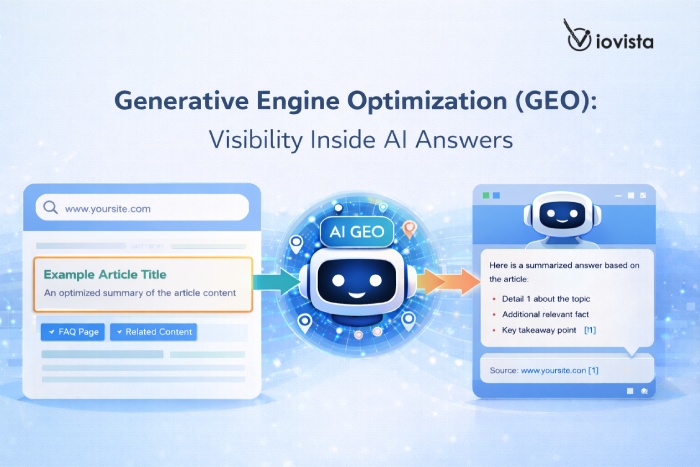
Generative Engine Optimization (GEO) is the next evolution of eCommerce SEO, designed for a world where buyers increasingly receive answers, summaries, and recommendations generated by AI rather than lists of links.
While traditional SEO focuses on rankings, LLM SEO focuses on AI understanding, and GEO determines whether your brand is included and how it is positioned inside AI-generated responses.
What Generative Engine Optimization Really Is
Generative Engine Optimization (GEO) is the practice of optimizing your brand’s digital presence so generative AI systems recognize, trust, and reference your business when producing answers.
These systems synthesize information from multiple sources to form a single response. GEO ensures your brand is not just discoverable, but contextually relevant and authoritative within that response.
For eCommerce brands, this means being present when AI tools summarize:
- Platform Comparisons
- Vendor Recommendations
- Feature Evaluations
- Implementation Considerations
This makes GEO a critical layer of SEO for AI-powered search engines.
Why GEO Matters More
AI-driven search experiences like Google’s generative results are reshaping discovery. In these environments, users may never scroll through traditional listings. Instead, they consume a synthesized answer that highlights a small set of trusted brands.
This is why Google SGE eCommerce optimization is becoming essential. GEO directly influences which brands are mentioned, how they are described, and what attributes are emphasized.
Without a GEO strategy, even well-ranked sites risk losing visibility as clicks decline, and AI summaries take center stage.
How GEO Works in Practice
Effective Generative Engine Optimization (GEO) focuses on entity clarity and consistency.
Key elements include:
- Clearly Defined Brand, Services, & Platform Expertise
- Structured Data that Reinforces Relationships Between Offerings
- Consistent Messaging Across Website Content & External Sources
- Authoritative Content that Explains Complex Topics Clearly
AI systems rely on these signals to determine credibility and relevance. When your brand’s entity is well defined, it becomes easier for AI tools to include you in generated answers.
GEO also strengthens broader AI search optimization strategies by ensuring your brand context remains accurate wherever AI systems reference it.
GEO & Its Relationship with LLM SEO & Traditional SEO
Generative Engine Optimization (GEO) does not replace other forms of SEO. It depends on them.
Traditional SEO ensures your content is indexed and authoritative. LLM SEO ensures your content is understandable. GEO ensures your brand is selected and positioned within AI-generated outputs.
Together, they form a future-ready eCommerce SEO strategy that addresses how buyers search, evaluate, and decide in 2026.
The Strategic Advantage of GEO for eCommerce Brands
GEO shifts the goal from traffic alone to influence. When your brand appears in AI-generated answers, it shapes buyer perception before a click ever happens.
For eCommerce brands investing in eCommerce SEO, Generative Engine Optimization (GEO) is how you stay visible in an AI-first discovery environment where being mentioned matters as much as being ranked.
Want to improve visibility inside generative search experiences? Get in Touch
Traditional SEO: The Revenue Engine Behind eCommerce SEO Services
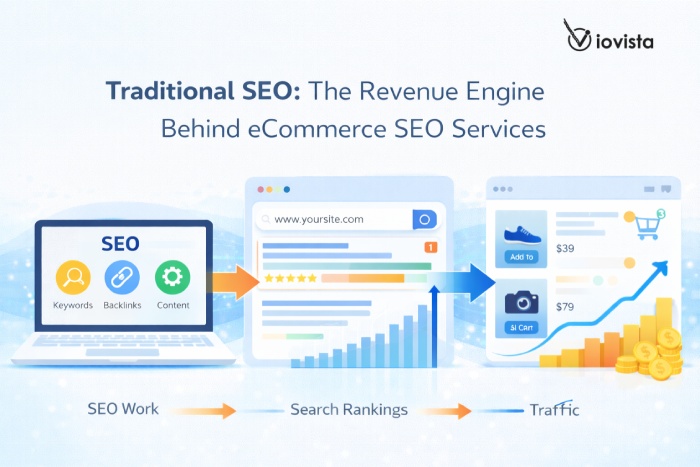
Despite the rise of AI-driven discovery, traditional SEO remains the commercial backbone of eCommerce SEO. While AI tools influence early research, search engines still dominate high-intent moments when buyers are actively comparing products, evaluating vendors, or preparing to convert.
Traditional SEO ensures your eCommerce site is discoverable, indexable, and competitive at these critical decision points.
Why Traditional SEO Still Matters?
Traditional SEO continues to drive transaction-ready traffic, especially for:
- Product-Specific Searches
- Category & Collection Pages
- Brand & Platform-Based Queries
- Comparison & Evaluation Searches
When a buyer searches with intent, such as a platform name, solution type, or product attribute, search engines remain the primary gateway. Strong rankings at this stage directly influence pipeline and revenue.
For this reason, traditional SEO remains a foundational layer of any feature-ready eCommerce SEO strategy.
How Has Traditional SEO Evolved?
In 2026, traditional SEO is no longer about keyword density or isolated optimizations. It has evolved into a holistic system focused on relevance, authority, and user experience.
Modern traditional SEO prioritizes:
- Clean Site Architecture & Logical Navigation
- Fast-Loading Pages Optimized for Mobile-First Indexing
- Clear Category Hierarchies that Support Large Catalogs
- Content Depth that Demonstrates Topical Authority
Search engines now evaluate how well your entire site explains a subject, not just how well a single page targets a keyword.
The Role of Traditional SEO in AI-Powered Search
Even as SEO for AI-powered search engines becomes more important, traditional SEO still feeds these systems. AI tools rely heavily on search-engine-indexed content to train, validate, and reference answers.
In other words, if your pages are poorly optimized for traditional SEO, they are less likely to be surfaced or trusted by AI systems later. This makes traditional SEO a prerequisite for LLM SEO and Generative Engine Optimization (GEO).
Strong technical SEO, structured content, and clear on-page signals improve both rankings and AI interpretability.
Where Traditional SEO Falls Short Alone
While traditional SEO excels at capturing demand, it does not fully address:
- AI-Generated Summaries that Reduce Clicks
- Conversational & Exploratory Queries
- Brand Positioning Inside Generative Answers
This limitation is why traditional SEO must now work alongside AI search optimization strategies and Google SGE (Search Generative Experience) eCommerce optimization, rather than operating in isolation.
The Strategic Takeaway
Traditional SEO is not outdated; it’s just incomplete on its own.
For eCommerce brands investing in eCommerce SEO, traditional SEO provides the revenue foundation. It captures intent, supports conversions, and enables visibility across search engines. But its true power is unlocked when integrated into a broader, AI-aware SEO ecosystem.
Without a strong traditional SEO base, no AI-focused strategy can scale effectively.
Do you want stronger rankings and higher-intent organic traffic? – Let’s Talk
LLM SEO vs GEO vs SEO: A Tabular Comparison
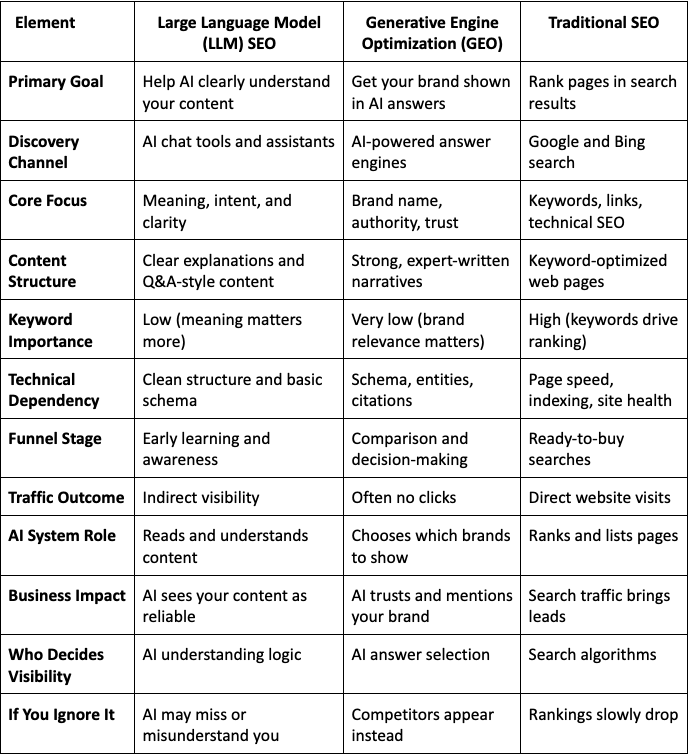
The LLM SEO vs GEO vs SEO comparison explains how traditional rankings, AI understanding, and generative visibility work together in modern search.
How Do SEO, LLM SEO, & GEO Work Together
A single optimization tactic no longer drives eCommerce visibility. Success stems from the effective integration of traditional SEO, LLM SEO, and Generative Engine Optimization (GEO) as a unified system.
- Traditional SEO underpins eCommerce SEO by ensuring crawlability, authority, and visibility for high-intent searches. Optimized product pages, category structures, and technical performance continue to drive revenue.
- Large Language Model (LLM) SEO extends this foundation by making content easy for AI systems to understand and reference. It is critical for SEO for AI-powered search engines, where clarity and intent outweigh keyword usage.
- Generative Engine Optimization (GEO) ensures your brand is included and positioned correctly within AI-generated answers. It supports Google SGE eCommerce optimization and strengthens overall AI search optimization strategies.
When aligned, these three approaches support a future-ready eCommerce SEO strategy. Traditional SEO captures demand, LLM SEO enables AI understanding, and GEO ensures influence inside generative experiences. Together, they maximize visibility, trust, and long-term growth across every modern discovery channel.
How Does ioVista Lead eCommerce Brands with LLM SEO?
ioVista helps eCommerce brands adapt to how AI-powered search actually works. Our approach to LLM SEO focuses on structuring product content, category pages, and brand messaging so AI systems can clearly understand, interpret, and trust your expertise across emerging search experiences.
Through our AI SEO services, we go beyond traditional optimization to align semantic clarity, entity signals, and structured data with how AI-powered search engines evaluate relevance. This ensures your brand is accurately represented in AI-driven responses, recommendations, and summaries that influence buyer decisions long before a click happens.
By integrating LLM SEO with traditional SEO and Generative Engine Optimization (GEO), ioVista delivers a future-ready eCommerce SEO strategy built for long-term visibility and growth.
Connect with ioVista’s AI experts to explore our AI SEO services and build a search strategy designed for 2026 and beyond.
Frequently Asked Questions (FAQs)
1. What is AEO?
AEO (Answer Engine Optimization) is the practice of structuring and optimizing content so AI-powered systems can extract precise answers and deliver them directly to users.
For eCommerce brands, AEO helps your products and expertise appear in AI-generated responses, voice assistants, and AI search summaries, often before users click through to your site.
2. What is GEO?
GEO (Generative Engine Optimization) focuses on ensuring your brand is included and positioned correctly inside AI-generated answers, recommendations, and summaries.
Unlike traditional SEO, GEO is not about ranking pages; it’s about being the trusted option AI systems cite or reference when generating responses.
3. How is LLM SEO different from traditional SEO?
LLM SEO focuses on how AI models understand and interpret content, not just how search engines rank pages. It prioritizes semantic clarity, structured context, and factual accuracy so AI systems can confidently reference your brand.
Traditional SEO, on the other hand, focuses on crawlability, keyword rankings, and click-through performance. In 2026, both are essential but serve different discovery channels.
4. How does LLM SEO impact AI-generated answers?
LLM SEO directly affects whether AI systems can confidently reference your brand when generating answers, comparisons, and recommendations.
When your content is structured for clarity, context, and factual consistency, AI models are more likely to use it as a trusted source. This increases your visibility inside AI-powered search and supports a future-ready eCommerce SEO strategy.
Mike Patel


Mike Patel is the Founder and CEO of ioVista, a leading digital commerce agency specializing in eCommerce solutions. With a strong background in business and technology, Mike Patel has been at the forefront of driving digital transformations for businesses. He has successfully navigated the ever-changing landscape of eCommerce, helping companies leverage the power of online platforms to grow their brand, increase revenues, and optimize their digital presence. Under his leadership, ioVista has become a trusted partner with major technology companies: Adobe/Magento, Google, BigCommerce, Shopify, and Yahoo. He is dedicated to staying ahead of industry trends, adopting cutting-edge technologies, and continuously improving strategies to provide clients with a competitive edge. Mike’s commitment to excellence and client satisfaction is evident in every project ioVista undertakes.
Popular Posts
-
-
News
How ShopWare and ioVista are Driving Digital Transformation in the 2A Community!
Aaron Pallares
04 Aug 2026 -
News
Why ioVista Became a Shopware Partner: Building the Future of Digital Commerce Through Innovation and Collaboration
Aaron Pallares
28 Jul 2026 -
Adobe Commerce, Magento, Update
Critical Adobe Commerce Security Update APSB26-73: Key Highlights
Mike Patel
15 Jul 2026 -
AI and ML, Google Updates
Google Marketing Live 2026: Everything You Need to Know about Google's AI Advertising Revolution
Mike Patel
16 Jun 2026 -
Adobe Commerce
Critical Adobe Commerce Security Update APSB26-49: Key Highlights
Mike Patel
15 May 2026 -
Adobe Commerce
Adobe Commerce 2.4.9 is Here: Features, Security, and Platform Enhancements
Mike Patel
15 May 2026 -
-
-
-
AI and ML, AIO, B2B
Machine-Readable B2B: The Hidden Layer that Wins AI Visibility
Mike Patel
14 Apr 2026 -
B2B
AI-Ready Catalogs: Turning Your Product Data into a Recommendation Engine
Mike Patel
09 Apr 2026 -
-
-
AIO, SEO
LLM Optimization: How Large Language Models Discover, Rank, and Cite Content
Mike Patel
26 Mar 2026 -
Migration, SEO
SEO Website Migration Checklist: Guide to Protect Your Rankings & Traffic in 2026
Mike Patel
13 Mar 2026 -
Adobe Commerce, Update
Adobe Commerce Security Update APSB26-05: Everything You Need to Know
Mike Patel
12 Mar 2026 -
AIO, SEO
LLM SEO vs GEO vs SEO: What Actually Matters for eCommerce Brands in 2026
Mike Patel
12 Mar 2026 -
Adobe Commerce
Are You Still on Adobe Commerce 2.4.6? Now is the Time to Upgrade
Mike Patel
24 Feb 2026 -
-
-
-
-
AI and ML, SEO
AI-SEO Is Changing Everything in 2026: 5 Strategies to Rank and Stay Relevant
Mike Patel
10 Dec 2025 -
-
E-Commerce
What SEMA 2025 Revealed: The Digital Transformation Race in the Automotive Aftermarket Industry
Mike Patel
20 Nov 2025 -
Adobe Commerce
Most Exciting Update: Hyvä Theme is Now Open Source and FREE
Paren Sutreja
17 Nov 2025 -
News, Shopify
Breakthrough Update: Managing Product Variants on Shopify Got Easier with 2048 Variants
Mike Patel
11 Nov 2025 -
Adobe Commerce, Update
Critical Adobe Commerce Vulnerability (CVE-2025-54236): What Merchants Need to Know
Mike Patel
27 Oct 2025 -
Adobe Commerce, Update
Adobe Commerce Security Update APSB25-94: What You Need to Know
Mike Patel
15 Oct 2025 -
Shopify
The Quiet Revolution: Why the Shopify x ChatGPT Partnership Changes Everything in eCommerce
Mike Patel
03 Oct 2025 -
Adobe Commerce
Adobe Sensei AI in eCommerce 2025: Transforming Digital Commerce
Mike Patel
19 Sep 2025 -
Adobe Commerce
Critical Adobe Commerce Security Update APSB25-88: Key Highlights
Mike Patel
10 Sep 2025 -
Shopify
Shopify API Deprecations and New Features: A Merchant's Guide to Upcoming Changes
Mike Patel
08 Sep 2025 -
AI and ML
Agentic AI for Business - Drive Success with Intelligent Automation
Mike Patel
27 Aug 2025 -
Adobe Commerce, Update
Adobe Commerce Security Update APSB25-71: Essential Security Fixes You Need to Know
Mike Patel
13 Aug 2025 -
News, Shopify
Shopify Summer Edition 2025: A Technical Insight into the Latest Update
Mike Patel
08 Aug 2025 -
-
Adobe Commerce, Magento
Adobe Commerce Security Update APSB25-50: Key Highlights
Mike Patel
11 Jun 2025 -
Adobe Commerce, B2B, E-Commerce
B2B Excellence Starts with Adobe Commerce (Magento) - Not WooCommerce
Mike Patel
03 Jun 2025 -
AI and ML, B2B, Digital Marketing, E-Commerce, Web Development
AI and ML in B2B: A Vision for the Future of Commerce by 2025
Mike Patel
27 May 2025 -
B2B, Digital Marketing, E-Commerce, Web Development
20 Next-Gen B2B eCommerce Features that will Dominate in 2025
Mike Patel
20 May 2025 -
B2B, BigCommerce, E-Commerce, Web Development
WooCommerce to BigCommerce Migration Fuels Your B2B eCommerce Growth
Mike Patel
06 May 2025 -
Adobe Commerce, E-Commerce, Migration, News, Web Development
Adobe Commerce SaaS: How Will It Empower Your eCommerce Business?
Mike Patel
22 Apr 2025 -
B2B, E-Commerce, Web Development
Leverage ERP Integration to Scale Your B2B eCommerce Business in 2025
Mike Patel
15 Apr 2025 -
Adobe Commerce, E-Commerce, Magento, News, Web Development
Adobe Commerce Security Update APSB25-26: All You Need to Know
Mike Patel
10 Apr 2025 -
Adobe Commerce, E-Commerce, Magento, News, Web Development
Adobe Commerce 2.4.8 Release: Key Highlights
Mike Patel
10 Apr 2025 -
B2B, E-Commerce, Migration, Web Development
Why Scaling Business Should Migrate WooCommerce Stores to Shopify
Mike Patel
08 Apr 2025 -
Adobe Commerce, B2B, E-Commerce, Magento, Web Development
Why Does Adobe Commerce (Magento) Lead the Way of B2B eCommerce
Mike Patel
18 Mar 2025 -
B2B, Digital Marketing, E-Commerce, Web Development
Gain a Competitive Edge by Turning Obstacles into Opportunities: B2B Digital Transformation in 2025
Mike Patel
11 Mar 2025 -
AI and ML, B2B, Digital Marketing, E-Commerce, Web Development
10 Key Drivers of Digital Transformation in B2B eCommerce for 2025
Mike Patel
04 Mar 2025 -
B2B, E-Commerce, Web Development
5 Leading eCommerce Platforms to Build Scalable B2B Customer Portals
Mike Patel
25 Feb 2025 -
Google Updates, News, SEO
Google Search Ranking Volatility: All You Need to Know
Mike Patel
18 Feb 2025 -
Adobe Commerce, E-Commerce, Magento, News, Web Development
Adobe Commerce Security Update APSB25-08: All You Need to Know
Mike Patel
13 Feb 2025 -
B2B, E-Commerce, Web Development
7 Strategic Benefits of an Online B2B Customer Portal
Mike Patel
11 Feb 2025 -
B2B, E-Commerce, Web Development
What Makes a Great Online B2B Customer Portal? Top 10 Features to Know
Mike Patel
04 Feb 2025 -
B2B, E-Commerce, Web Development
Legacy B2B eCommerce Systems Slowing You Down? It's Time for Modernization
Mike Patel
28 Jan 2025 -
B2B, E-Commerce, Manufacturing, Migration, Web Development
80% of B2B Businesses Are Holding You Back by Legacy eCommerce Systems. Is Yours One of Them?
Mike Patel
15 Jan 2025 -
B2B, E-Commerce, Manufacturing, Web Development
Essential B2B Commerce Features for 2024
Mike Patel
20 Nov 2024 -
Adobe Commerce, E-Commerce, Magento, News, Web Development
Security Update Available for Adobe Commerce | APSB24-90
Albert Wood
20 Nov 2024 -
Adobe Commerce, E-Commerce, Magento, News
Why Choose Hyvä Enterprise for Your Adobe Commerce Store?
Paren Sutreja
19 Nov 2024 -
Adobe Commerce, E-Commerce, Magento, News
Security Update APSB24-73 for Adobe Commerce: Everything You Need to Know
Albert Wood
14 Oct 2024 -
Adobe Commerce, E-Commerce, Magento, News, Web Development
CosmicSting Exploit Still Poses a Threat
Albert Wood
25 Jul 2024 -
Adobe Commerce, E-Commerce, Magento, News
CosmicSting: Unauthorized XXE Vulnerability
Albert Wood
17 Jul 2024 -
Adobe Commerce, E-Commerce, Magento, News
Hyvä Theme for Magento 2: Uncover Powerful Features – Evaluate Pros and Cons
Paren Sutreja
16 Jul 2024 -
Adobe Commerce, Magento, News, Web Development
Magento 2.4.7: Explore the Newest Enhancements and Features
Albert Wood
30 Apr 2024 -
Adobe Commerce, Magento, News, Web Development
Magento 2.4.6-p5: Enhancing Stability and Security
Mike Patel
22 Apr 2024 -
-
Digital Marketing, E-Commerce, SEO
The Impact of Site Speed on eCommerce SEO Performance
Mike Patel
14 Feb 2024 -
Awards & Recognition, B2B, BigCommerce, E-Commerce, Manufacturing, Web Development
ioVista Attains B2B Specialization on BigCommerce
Albert Wood
30 Oct 2023 -
Adobe Commerce, BigCommerce, Digital Marketing, E-Commerce, Magento, SEO
5 Ways to Boost eCommerce Sales in 2024
Mike Patel
21 Sep 2023 -
Adobe Commerce, Awards & Recognition, B2B, E-Commerce, Magento, Manufacturing, Web Development
It’s Official: ioVista Has Become a Recognized Adobe Specialized Partner
Albert Wood
05 Sep 2023 -
Adobe Commerce, E-Commerce, Magento, News, Web Development
Magento 2.4.7-beta1 Release
Mike Patel
15 Aug 2023 -
-
Awards & Recognition, B2B, E-Commerce, Manufacturing, Web Development
ioVista Announced as a 2023 Local Excellence Award Winner by UpCity
Albert Wood
09 May 2023 -
Digital Marketing, E-Commerce, News
Google Analytics 4: What You Need To Know
Albert Wood
29 Mar 2023 -
Adobe Commerce, E-Commerce, Magento, News, Web Development
Adobe Commerce 2.4.6 Release
Mike Patel
13 Mar 2023 -
Adobe Commerce, E-Commerce, Magento, Web Development
Questions You Should Ask Your Magento Agency
Albert Wood
17 Feb 2023 -
B2B, Digital Marketing, E-Commerce, Manufacturing, Web Development
7 Proven Strategies to Increase B2B/Wholesale eCommerce Revenue
Mike Patel
01 Feb 2023 -
Digital Marketing, E-Commerce
10 eCommerce Trends to Increase your Sales in 2023
Albert Wood
12 Jan 2023 -
B2B, E-Commerce, Manufacturing, Web Development
B2B eCommerce Features Your Store Need in 2023
Albert Wood
05 Jan 2023 -
Adobe Commerce, E-Commerce, Magento, News, Web Development
Adobe/Magento Highlights 2022 - Is your store Up-to-Date
Mike Patel
20 Dec 2022 -
BigCommerce, E-Commerce, News, Web Development
BigCommerce Releases StagingPro for Enterprise Merchants and Agency Developers
Albert Wood
15 Dec 2022 -
Adobe Commerce, E-Commerce, Magento, News, Web Development
Adobe discontinues Support for the 2.4.0-2.4.3 Release Line
Mike Patel
09 Dec 2022 -
-
Digital Marketing, E-Commerce, News
Universal Analytics Going Away: What Does it Mean, What you need to Do?
Albert Wood
24 Nov 2022 -
Adobe Commerce, E-Commerce, Magento, News
40% of Magento and Adobe Commerce Websites at Risk in November 2022
Albert Wood
17 Nov 2022 -
E-Commerce, Web Development
Website Support: How Can ioVista Help keep your Store Up and Running During Holidays
Mike Patel
17 Nov 2022 -
Awards & Recognition, B2B, E-Commerce, Manufacturing, News
ioVista Awarded the Best B2B Company 2022
Albert Wood
04 Nov 2022 -
Adobe Commerce, Magento, News
Adobe Releases Critical Security Patches for Magento 2.4.5 and 2.4.4
Albert Wood
27 Oct 2022 -
-
E-Commerce, News
ioVista is Sponsoring the Largest eCommerce Event in Dallas
Albert Wood
07 Oct 2022 -
Adobe Commerce, E-Commerce, Magento, News
Magento 2 Vulnerability: Surge in Hacking on Unpatched Stores
Mike Patel
27 Sep 2022 -
B2B, Digital Marketing, E-Commerce
Get your Holiday eCommerce Marketing Started with These 5 Tips
Albert Wood
15 Sep 2022 -
Adobe Commerce, B2B, E-Commerce, Magento
Why a Magento Code Audit is Essential for your eCommerce Store
Mike Patel
10 Sep 2022 -
-
-
B2B, BigCommerce, E-Commerce
How BigCommerce makes it easy for Legacy Businesses to get started with B2B eCommerce
Mike Patel
23 Aug 2022 -
B2B, E-Commerce, Manufacturing
The Challenges of eCommerce in Manufacturing and How to Overcome Them
Mike Patel
17 Aug 2022 -
B2B, E-Commerce, Magento, News
Adobe Releases Magento Open Source and Adobe Commerce 2.4.5
Mike Patel
10 Aug 2022




























Let’s work together to create outstanding digital experiences.
With 20+ years of industry experience, ioVista understands your eCommerce needs and delivers best-in-class solutions that help you gain a competitive edge.
or Call us at: +1 214-699-4391

TOP
Get in Touch