


An Exclusive Guide to Generative AI (2025 & Beyond)
04 Dec 2025
 Mike Patel

Artificial Intelligence (AI) has been transforming the conventional way industries and businesses operate. By introducing several advanced tools and technologies, AI has significantly empowered people’s day-to-day lives. Generative AI (GenAI) is one of the technologies that is reshaping human mindset and various domains by unlocking new possibilities.
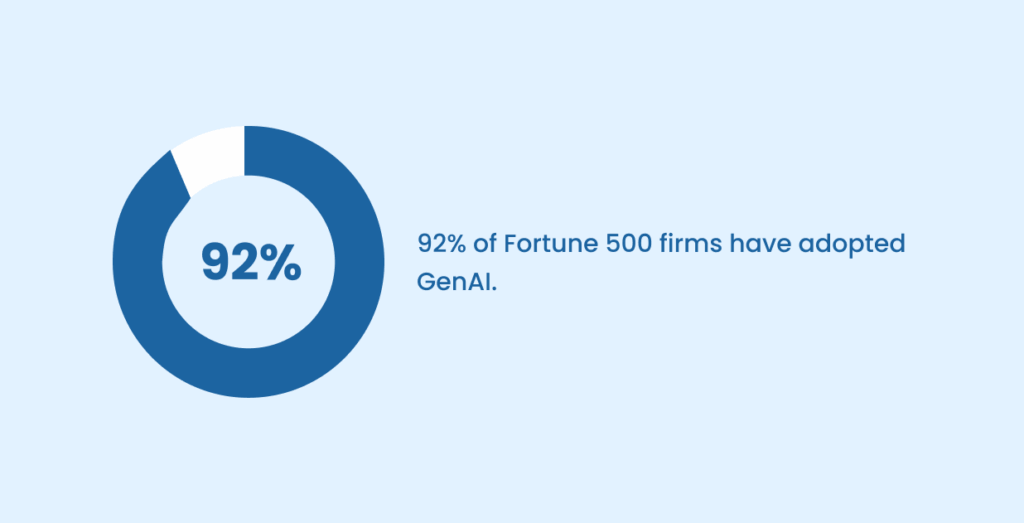
Generative AI is capable of creating a wide range of content, including text, images, videos, etc. Creating high-quality, original, and human-like text, the technology helps businesses streamline various operations. According to research, 92% of Fortune 500 firms have adopted GenAI.
To leverage the full potential of the technology, it is essential to understand the fundamental aspects of generative AI.
Let’s begin with the definition.
What is Generative AI?
Generative AI describes algorithms that can be used to create new content, including audio, code, images, text, simulations, and videos.
McKinsey & Company
GenAI generates content in various forms, including text, visuals, voice, and synthetic data, by harnessing the power of deep learning and large language models. Unlike traditional AI models that generate new content using existing data available on the internet, generative AI learns patterns from a huge amount of data to create genuine content.
Built using AI technologies, such as deep learning, machine learning, and neural networks, GenAI understands the data structure and creates new content that looks human-written.
The evolution of GenAI has impacted all industries with advancements in foundation models and large language models such as GPT. It optimizes processes for businesses such as marketing, entertainment, healthcare, and more.
How Does Generative AI Work? A Brief Overview
If you are curious about how generative AI works, we would like to provide you with an understanding of how deep learning, machine learning, and neural networks work in sync to learn data patterns and create content. Here’s the process of how GenAI works to deliver effective results.

Model Training
This technology uses supervised learning to train the model. It processes large data sets, including text, images, audio, videos, and more, analyzes patterns, and identifies relationships within the input data by considering underlying content rules. Based on the assessment, GenAI generates new data from the learned probability distribution.
For example,
You want to create a story using a generative AI tool. Enter the appropriate prompt in the tool. The AI model processes massive data to analyze writing style, themes, and genres. With a supervised learning approach, the technology applies all the modern rules while creating the content.
Continuous Improvement
After training, the model continuously adopts content writing parameters to maximize the probability of producing accurate results. Based on the prompt provided by users, the GenAI model updates the output.
For instance,
To create a romantic story, you need to provide refined prompts continuously to the tool. The model improves the output based on your feedback.
Refines Results Through Inference
When you use GenAI models, you create new content by sampling from the lead distribution. It optimizes the output through a process called “inference.” When you provide an updated prompt, the model creates unique content through inference.
Inference Adjustment
During inference, the GenAI model adjusts its output to meet the users’ expectations or reduce errors. It ensures the output becomes more realistic and aligns with users’ objectives. Moreover, users can create extremely relevant writing by providing prompts in a precise style, language, and tone.
Types of Generative AI Models that Empower Your Business Operations
GenAI offers a variety of models to meet the specific needs of various business applications of diverse industry verticals.
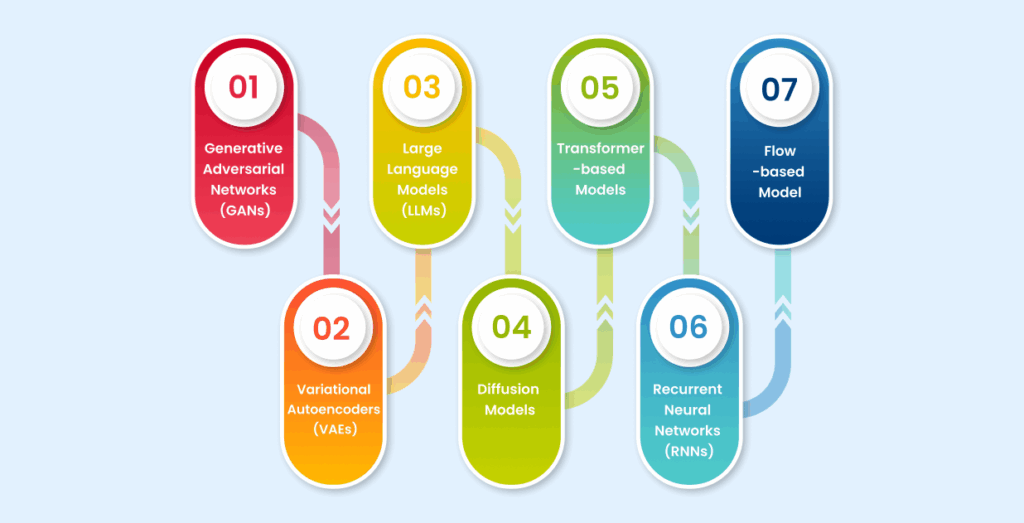
Generative Adversarial Networks (GANs)
Introduced in 2014, GANs are a pioneer and widely used AI model. It consists of two neural networks: “Generator” and “Discriminator.” These networks compete to generate more valuable content.
- Generator: Creates new data based on the training data
- Discriminator: Analyzes the data to determine whether it is real or generated
GANs successfully create realistic content and meet diverse requirements of various applications, such as cybersecurity, data synthesis, and art creation, through AI training.
Variational Autoencoders (VAEs)
Variational autoencoders are a GenAI model that encodes input data, optimizes and simplifies the content, and stores data in a latent space (a hidden storage area). The technology pulls data from the latent space and reconstructs it to resemble the actual form of information. VAEs are highly used to create AI-powered images and text.
Large Language Models (LLMs)
LLMs are the latest and widely used AI models for generating high-quality content. Trained through extensive text-based content, these models provide structured data to GenAI tools to perform various tasks, including data translation, data summarization, and generating human-like text. OpenAI’s GPT and Google’s BERT are examples of LLM-based GenAI platforms.
Diffusion Models
Diffusion models are used to create high-quality images and videos. These models are considered the latest innovation in GenAI.
Unlike traditional methods, diffusion models can enhance image quality by refining the probability distribution of pixels. These models are used in various industrial applications, including fashion designing, photorealistic rendering, medical imaging, digital art creation, and more.
Transformer-Based Models
Transformer models are powered by machine learning and natural language processing. It transforms the way machines understand and generate content.
This model analyzes relationships among various data points to produce text and images more accurately and quickly. These models effectively perform tasks like language translation, data retrieval, and more.
Recurrent Neural Networks (RNNs)
RNNs are used to process and create sequential data. Based on training, the RNN generates a new data sequence that is similar to the learned data. The model predicts what comes next in the data sequence by analyzing what happened in the previous sequence. The best examples of RNN AI models are Siri and Google Voice Search.
Flow-Based Model
Transform your complex data distribution into a simple one by harnessing the potential of flow-based models. This model is typically used for image creation.
Each of the GenAI models listed is powerful in transforming your operations. By considering suitable models, businesses from different sectors, from healthcare to entertainment, can thrive.
Key Benefits of Considering Generative AI for Your Business
GenAI transforms the way industry operations are conducted through innovation, creative empowerment, and process automation. It enables organizations and individuals to be more productive, discover new opportunities, and ensure cost control.
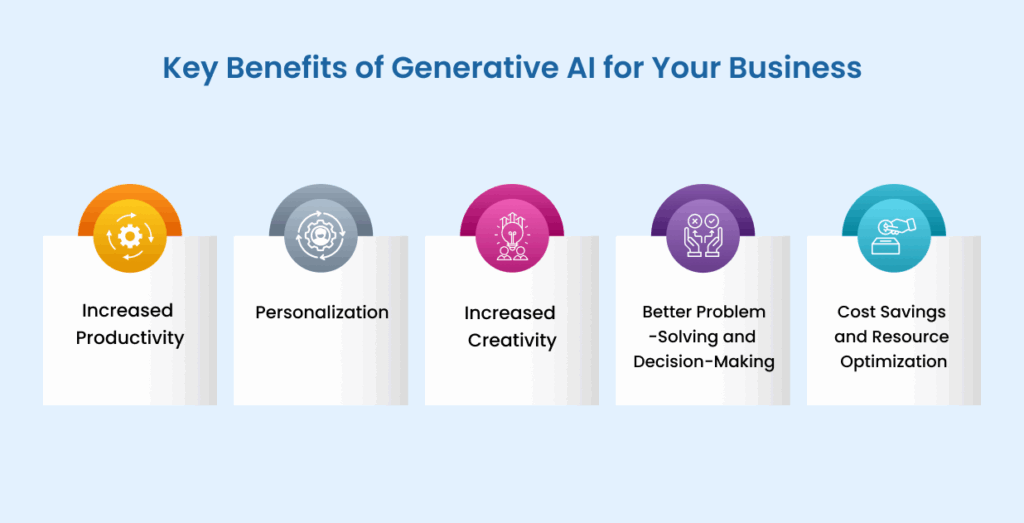
Increased Productivity
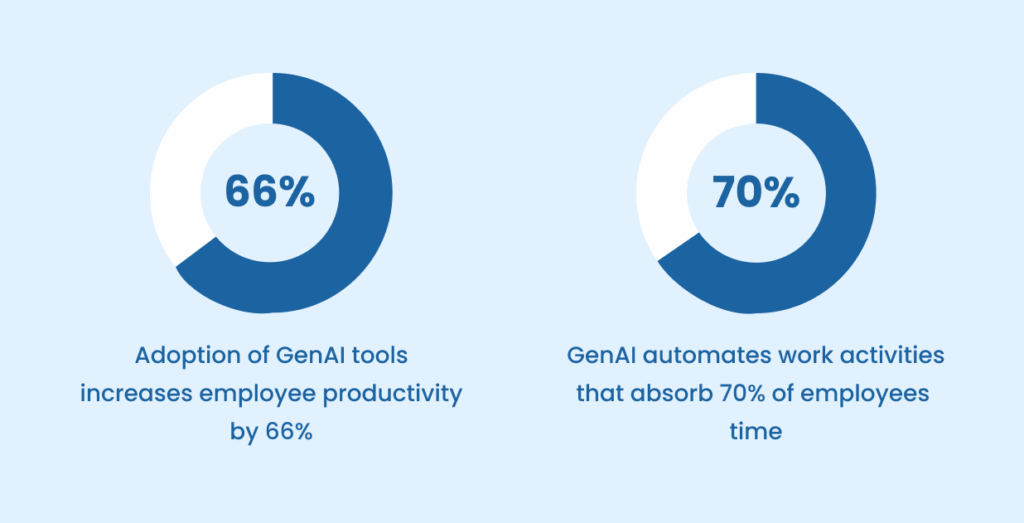
A survey found that the adoption of GenAI tools increases employee productivity by 66%. According to McKinsey’s research, GenAI automates work activities that absorb 70% of employees’ time.
Gen AI automates various organizational processes, including streamlining workflow development, content creation, and enhancing decision-making. From creating code to virtual assistance through chatbots, the technology helps organizations reduce the workload of human teams, perform more creative and intelligent tasks, and improve productivity and efficiency.
Personalization
By analyzing the large datasets, the technology learns individual preferences and behaviors to provide personalized recommendations and experiences. The result of considering personalization is improved customer engagement, conversions, and satisfaction.
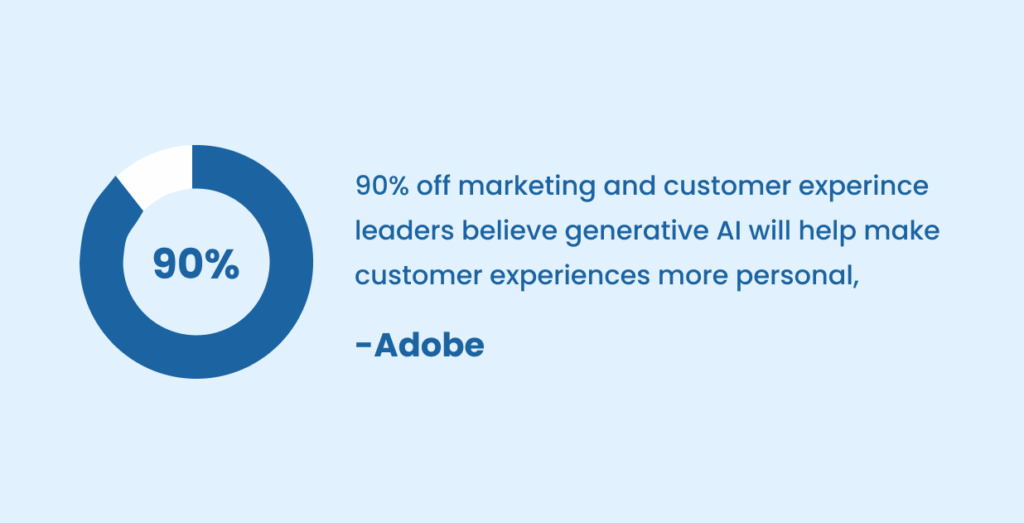
90% of marketing and customer experience leaders believe generative AI will help make customer experiences more personal.
For example,
Netflix movie recommendations and eCommerce site product suggestions based on past purchases.
Increased Creativity
Creative individuals such as writers, artists, and designers leverage GenAI to generate unique text and image-based content by automating repetitive tasks.
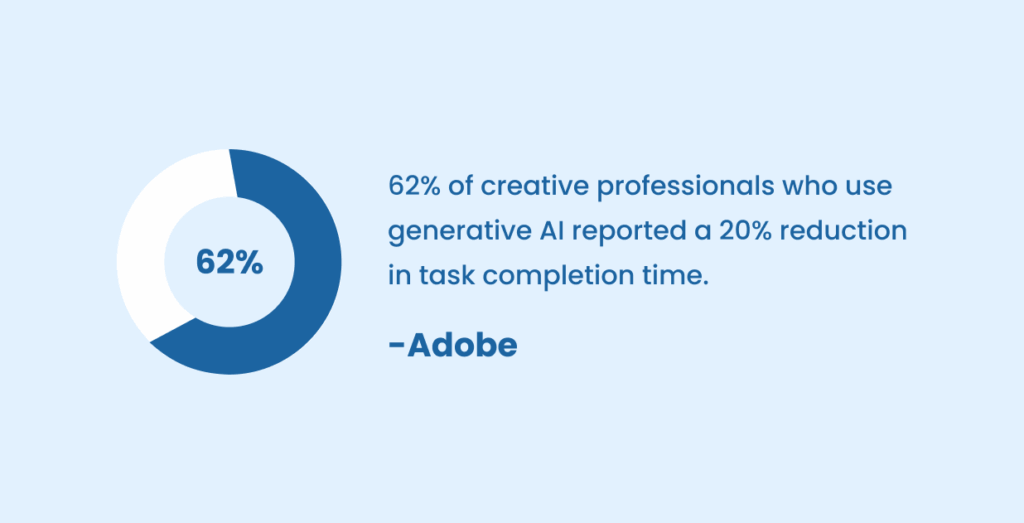
According to Adobe research, 62% of creative professionals who use generative AI reported a 20% reduction in task completion time. The latest AI tools, such as DALL·E, Jasper, and MidJourney, accelerate creative directions for individuals.
Better Problem-Solving and Decision-Making
Generative AI aggregates a massive amount of data, detects patterns, and consolidates insights that help brands make strategic business decisions.
For example,
Using AI-generated predictive models, manufacturers can optimize their supply chain while fintech organizations detect fraud.
Cost Savings and Resource Optimization
Several tasks take considerable human time and effort. By automating such tasks, generative AI helps businesses keep operational costs low.
For example,
You can generate marketing copy that reduces your manual typing tasks and effort for idea search. Moreover, GenAI can produce a video and eliminate the video production costs.
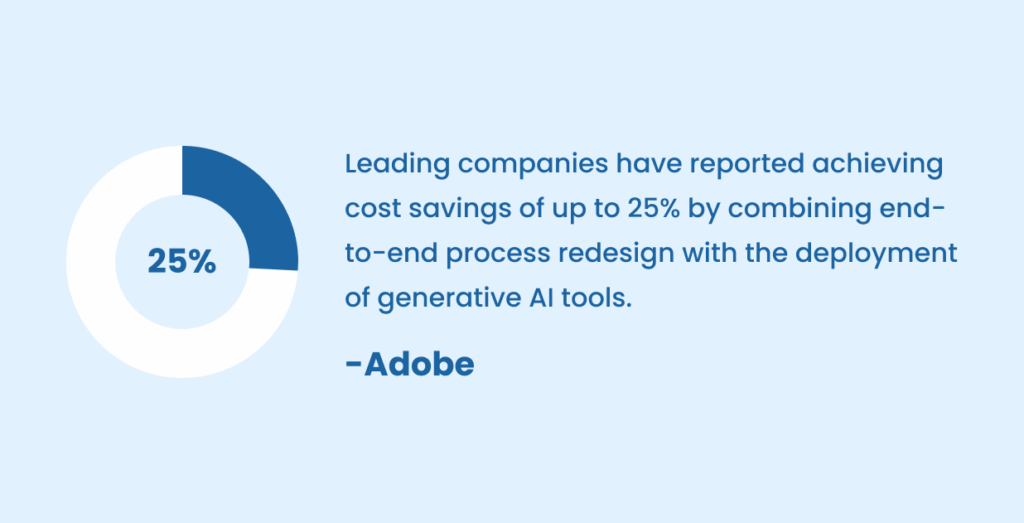
Leading companies have reported achieving cost savings of up to 25% by combining end-to-end process redesign with the deployment of generative AI tools.
Best Practices for Implementing Generative AI Successfully
Building and implementing GenAI solutions requires a strategic approach to ensure reliability and optimal performance. To mitigate unexpected risks associated with AI platforms, it is essential to prioritize data security, governance, and quality. Here are the best practices brands should follow to unleash the full potential of GenAI.
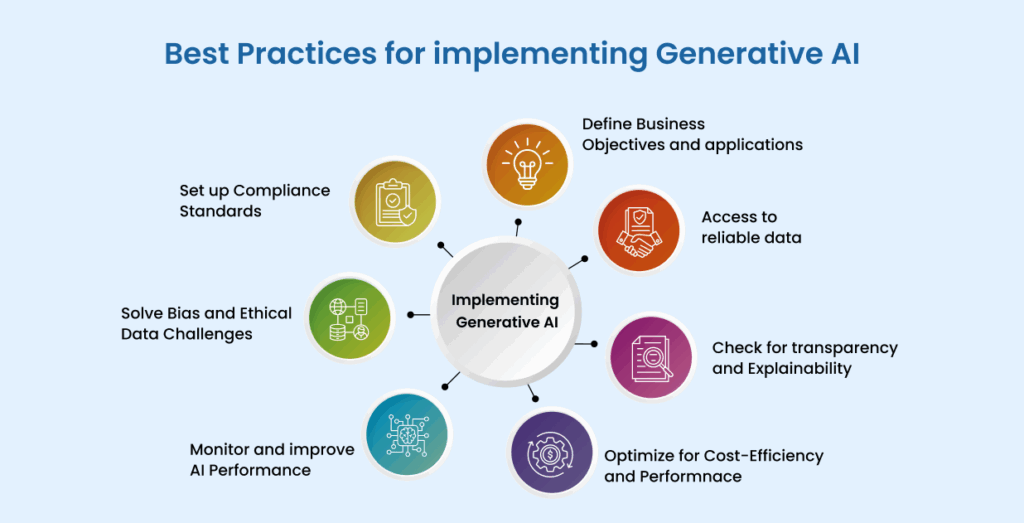
Define Business Objectives and Applications
Before considering GenAI development services, identify specific business problems or applications that can be solved using the technology.
Most common use cases of GenAI implementation include
- Customer support (virtual assistance, chatbots, and more)
- Content creation (design generation, automated reports, and more)
- Data augmentation (filling gaps in datasets)
With the right strategy, you can build a robust AI platform that aligns with your business objectives and improves productivity.
Access to Reliable Data
To generate effective output, GenAI models learn from a vast database. Moreover, data quality impacts the AI performance and results. To gain protection against information and biases, you need to
- Avoid using proprietary or copyrighted data that may cause legal risks
- Conduct regular data audits to filter out inaccuracies
- Collect data from diverse sources that ensure reliability
Set Up Compliance Standards
To mitigate privacy and security risks, AI-generated data should be managed with the right set of compliance strategies and standards. Brands should consider
- Implementing the widely accepted compliance standards, including GDPR, CCPA, and other data privacy regulations
- Using a secure cloud infrastructure for data storage and processing
- Testing AI models regularly to identify potential risks
Check for Transparency and Explainability
Many AI models do not reveal their data processing methods. Therefore, it is challenging to comprehend how they produce output. To build trust and reliability, brands should take care of certain aspects, including
- Consider AI models that provide explainable decision-making
- Track AI-derived decisions through regular audit trails
Solve Bias and Ethical Data Challenges
AI-generated content has unintended bias issues that sometimes lead to discriminatory results. To address such outcomes, brands need to
- Introduce policies for ethical and responsible use of AI
- Train models with balanced datasets to boost representation
- Conduct regular audits and bias testing to be impartial
Optimize for Cost-Efficiency and Performance
Developing and implementing GenAI models is expensive. To manage the costs effectively, businesses can
- Leverage cost-effective and scalable deployment using cloud-based AI solutions
- Reduce computational load by considering model fine-tuning
- Select AI models that meet the required business applications
Monitor and Improve AI Performance
AI models should be updated regularly to remain relevant and efficient. To boost the solution performance, organizations should
- Refine AI-generated results by considering user feedback
- Enable AI deployment with an AI governance framework
- Periodic retraining with new data to enhance accuracy
How Is Generative AI Reshaping the Future?
According to Bloomberg research, generative AI will become a $1.3 trillion market by 2032. And North America holds 40.2% of the global share.
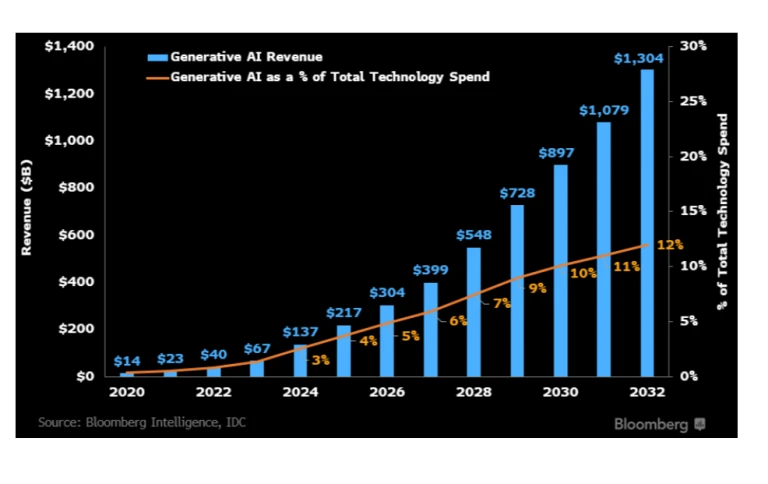
The above numbers show that generative AI is evolving rapidly. Not only that, it transforms the way industries and organizations operate. With the more advanced GenAI models, brands can reshape the future of their business.
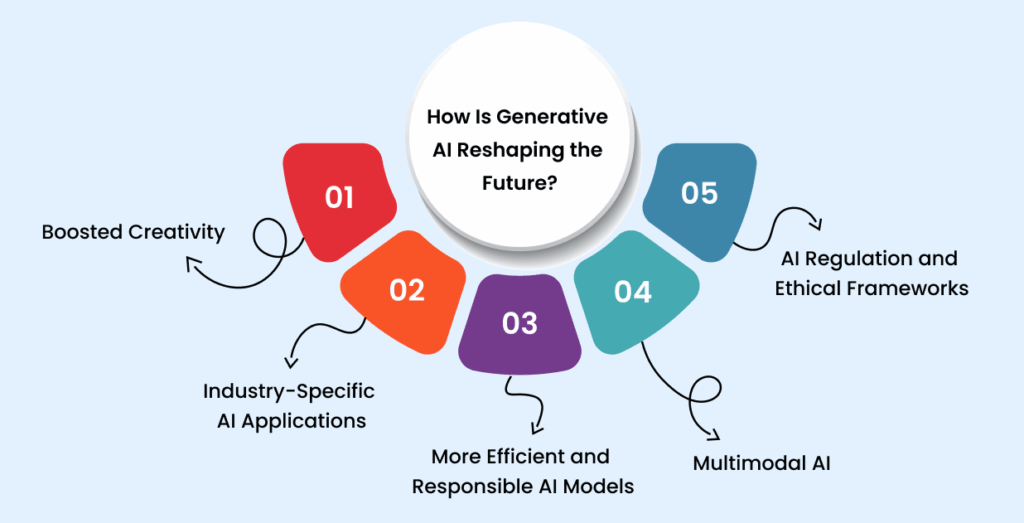
Boosted Creativity
The advanced GenAI will augment human creativity and work as a co-pilot. The market is introducing a wide range of tools that empower different artists, individuals, and businesses.
For instance,
AI assists creative artists such as writers and designers in creating high-quality and original content. It helps in generating music, 3D models, and a virtual environment. Using AI-powered creative tools, individuals and businesses empower their creative processes.
Industry-Specific AI Applications
With advancements in generative AI, there is a paradigm shift in the technology landscape. Now, you can find specific solutions for your highly specialized industry deployment.
- Retailers: Automates product descriptions, demand forecasting, and other operations
- Healthcare: Helps in diagnostics and drug discovery, and more
- Manufacturing: Ensures effective predictive maintenance, and more
This shift increases accuracy, compliance, and business value through domain-trained AI models.
More Efficient and Responsible AI Models
Next-generation AI isn’t just powerful; it’s optimized for speed, cost, and ethics. Efficiency and responsibilities are taking the front seat by introducing core performance metrics. The key components of modern AI models are
- Lightweight architectures reduce energy usage and inference costs
- Built-in bias detection improves fairness and trust
- Fine-tuned guardrails prevent harmful or misleading outputs
Multimodal AI
Generative AI is evolving beyond text-only systems into multimodal intelligence that understands and creates across formats.
- Combine text, image, audio, and video in a single model
- Generate marketing assets, analyze visual defects, or summarize meetings with mixed media inputs
This unlocks human-like comprehension and interaction across digital ecosystems.
AI Regulation and Ethical Frameworks
As generative AI becomes mainstream, governments and enterprises have started focusing on safety and accountability. Modern regulatory frameworks demand
- Transparency in AI model training
- Consent for data usage
- Safeguards against misinformation or bias
Companies must adopt auditable AI pipelines, responsible deployment policies, and continuous monitoring to ensure compliance and long-term trust.
Looking to Develop a Custom Generative AI Solution?
Generative AI is no longer an overhyped trend. It’s the key to staying successful in this competitive era. Businesses that strategically adopt GenAI will unlock automation, predictive insights, and smarter customer engagement, transforming operations across industries.
With ioVista’s expertise in custom generative AI development services, LLM fine-tuning, and enterprise integrations, organizations gain scalable, efficient, and responsible AI systems designed for measurable impact. We deliver tailored, secure, and integrated AI solutions that are not based on generic off-the-shelf models.
The future belongs to those who act today. Harness the power of generative AI by partnering with ioVista to build your competitive advantage and drive real-world results.
Frequently Asked Questions
How is Generative AI Different from Traditional AI?
Along with analyzing the data, generative AI creates new content in the form of text, images, audio, and video. The technology can produce entirely original outputs, enabling creative, human-like problem-solving across multiple domains. Whereas traditional AI primarily focuses on pattern recognition, prediction, and classification.
What are the Strengths of Generative AI?
- Generative AI produces highly realistic, human-like content, from text and visuals to audio and video.
- The technology accelerates innovation and automation through rapid prototyping, scenario simulations, and personalized solutions across industries. It enhances efficiency and reduces time-to-market.
What Types of Problems Can Generative AI Solve?
Generative AI addresses creative, analytical, and operational challenges. It can automate content creation, generate marketing materials, simulate scenarios, design products, provide predictive insights, and enhance customer engagement by delivering scalable solutions across the eCommerce, manufacturing, retail, wholesale, and distribution industries.
Mike Patel


Mike Patel is the Founder and CEO of ioVista, a leading digital commerce agency specializing in eCommerce solutions. With a strong background in business and technology, Mike Patel has been at the forefront of driving digital transformations for businesses. He has successfully navigated the ever-changing landscape of eCommerce, helping companies leverage the power of online platforms to grow their brand, increase revenues, and optimize their digital presence. Under his leadership, ioVista has become a trusted partner with major technology companies: Adobe/Magento, Google, BigCommerce, Shopify, and Yahoo. He is dedicated to staying ahead of industry trends, adopting cutting-edge technologies, and continuously improving strategies to provide clients with a competitive edge. Mike’s commitment to excellence and client satisfaction is evident in every project ioVista undertakes.
Popular Posts
-
 B2B, BigCommerce
BigCommerce B2B Edition Explained: Features, Pricing and Fit
Mike Patel
21 Sep 2026 -
BigCommerce, Migration, Shopify
BigCommerce vs. Shopify for B2B: A 2026 Decision Guide
Mike Patel
18 Sep 2026 -
AI and ML, AIO, B2B, E-Commerce
The Role of AI in Modern eCommerce: A B2B and B2C Guide

Aaron Pallares
16 Sep 2026 -
Shopify
Do You Need a Shopify Agency? A Guide for Growing B2B & D2C Businesses
Aaron Pallares
14 Sep 2026 -
Update
Adobe Commerce APSB26-138: What Businesses Need to Know About the Security Update
Albert Wood
10 Sep 2026 -
Adobe Commerce
Adobe Commerce APSB26-146: Critical Security Fixes Require Urgent Action
Albert Wood
08 Sep 2026 -
Adobe Commerce, SEO
Magento 2 SEO Guide for 2026: Advanced Strategies to Boost Rankings and Performance
Albert Wood
07 Sep 2026 -
-
-
-
Shopify
When Commerce Policies Change: What Regulated Merchants Can Learn from Shopify's Vape Decision
Albert Wood
18 Aug 2026 -
Adobe Commerce
Adobe Commerce APSB26-92: Security Risks, Affected Versions, and Next Steps
Albert Wood
13 Aug 2026 -
-
News
How ShopWare and ioVista are Driving Digital Transformation in the 2A Community!
Aaron Pallares
04 Aug 2026 -
News
Why ioVista Became a Shopware Partner: Building the Future of Digital Commerce Through Innovation and Collaboration
Aaron Pallares
28 Jul 2026 -
Adobe Commerce, Magento, Update
Critical Adobe Commerce Security Update APSB26-73: Key Highlights
Mike Patel
15 Jul 2026 -
AI and ML, Google Updates
Google Marketing Live 2026: Everything You Need to Know about Google's AI Advertising Revolution
Mike Patel
16 Jun 2026 -
Adobe Commerce
Critical Adobe Commerce Security Update APSB26-49: Key Highlights
Mike Patel
15 May 2026 -
Adobe Commerce
Adobe Commerce 2.4.9 is Here: Features, Security, and Platform Enhancements
Mike Patel
15 May 2026 -
-
-
-
AI and ML, AIO, B2B
Machine-Readable B2B: The Hidden Layer that Wins AI Visibility
Mike Patel
14 Apr 2026 -
B2B
AI-Ready Catalogs: Turning Your Product Data into a Recommendation Engine
Mike Patel
09 Apr 2026 -
-
-
AIO, SEO
LLM Optimization: How Large Language Models Discover, Rank, and Cite Content
Mike Patel
26 Mar 2026 -
Migration, SEO
SEO Website Migration Checklist: Guide to Protect Your Rankings & Traffic in 2026
Mike Patel
13 Mar 2026 -
Adobe Commerce, Update
Adobe Commerce Security Update APSB26-05: Everything You Need to Know
Mike Patel
12 Mar 2026 -
AIO, SEO
LLM SEO vs GEO vs SEO: What Actually Matters for eCommerce Brands in 2026
Mike Patel
12 Mar 2026 -
Adobe Commerce
Are You Still on Adobe Commerce 2.4.6? Now is the Time to Upgrade
Mike Patel
24 Feb 2026 -
-
-
-
-
AI and ML, SEO
AI-SEO Is Changing Everything in 2026: 5 Strategies to Rank and Stay Relevant
Mike Patel
10 Dec 2025 -
-
E-Commerce
What SEMA 2025 Revealed: The Digital Transformation Race in the Automotive Aftermarket Industry
Mike Patel
20 Nov 2025 -
Adobe Commerce
Most Exciting Update: Hyvä Theme is Now Open Source and FREE

Paren Sutreja
17 Nov 2025 -
News, Shopify
Breakthrough Update: Managing Product Variants on Shopify Got Easier with 2048 Variants
Mike Patel
11 Nov 2025 -
Adobe Commerce, Update
Critical Adobe Commerce Vulnerability (CVE-2025-54236): What Merchants Need to Know
Mike Patel
27 Oct 2025 -
Adobe Commerce, Update
Adobe Commerce Security Update APSB25-94: What You Need to Know
Mike Patel
15 Oct 2025 -
Shopify
The Quiet Revolution: Why the Shopify x ChatGPT Partnership Changes Everything in eCommerce
Mike Patel
03 Oct 2025 -
Adobe Commerce
Adobe Sensei AI in eCommerce 2025: Transforming Digital Commerce
Mike Patel
19 Sep 2025 -
Adobe Commerce
Critical Adobe Commerce Security Update APSB25-88: Key Highlights
Mike Patel
10 Sep 2025 -
Shopify
Shopify API Deprecations and New Features: A Merchant's Guide to Upcoming Changes
Mike Patel
08 Sep 2025 -
AI and ML
Agentic AI for Business - Drive Success with Intelligent Automation
Mike Patel
27 Aug 2025 -
Adobe Commerce, Update
Adobe Commerce Security Update APSB25-71: Essential Security Fixes You Need to Know
Mike Patel
13 Aug 2025 -
News, Shopify
Shopify Summer Edition 2025: A Technical Insight into the Latest Update
Mike Patel
08 Aug 2025 -
-
Adobe Commerce, Magento
Adobe Commerce Security Update APSB25-50: Key Highlights
Mike Patel
11 Jun 2025 -
Adobe Commerce, B2B, E-Commerce
B2B Excellence Starts with Adobe Commerce (Magento) - Not WooCommerce
Mike Patel
03 Jun 2025 -
AI and ML, B2B, Digital Marketing, E-Commerce, Web Development
AI and ML in B2B: A Vision for the Future of Commerce by 2025
Mike Patel
27 May 2025 -
B2B, Digital Marketing, E-Commerce, Web Development
20 Next-Gen B2B eCommerce Features that will Dominate in 2025
Mike Patel
20 May 2025 -
B2B, BigCommerce, E-Commerce, Web Development
WooCommerce to BigCommerce Migration Fuels Your B2B eCommerce Growth
Mike Patel
06 May 2025 -
Adobe Commerce, E-Commerce, Migration, News, Web Development
Adobe Commerce SaaS: How Will It Empower Your eCommerce Business?
Mike Patel
22 Apr 2025 -
B2B, E-Commerce, Web Development
Leverage ERP Integration to Scale Your B2B eCommerce Business in 2025
Mike Patel
15 Apr 2025 -
Adobe Commerce, E-Commerce, Magento, News, Web Development
Adobe Commerce Security Update APSB25-26: All You Need to Know
Mike Patel
10 Apr 2025 -
Adobe Commerce, E-Commerce, Magento, News, Web Development
Adobe Commerce 2.4.8 Release: Key Highlights
Mike Patel
10 Apr 2025 -
B2B, E-Commerce, Migration, Web Development
Why Scaling Business Should Migrate WooCommerce Stores to Shopify
Mike Patel
08 Apr 2025 -
Adobe Commerce, B2B, E-Commerce, Magento, Web Development
Why Does Adobe Commerce (Magento) Lead the Way of B2B eCommerce
Mike Patel
18 Mar 2025 -
B2B, Digital Marketing, E-Commerce, Web Development
Gain a Competitive Edge by Turning Obstacles into Opportunities: B2B Digital Transformation in 2025
Mike Patel
11 Mar 2025 -
AI and ML, B2B, Digital Marketing, E-Commerce, Web Development
10 Key Drivers of Digital Transformation in B2B eCommerce for 2025
Mike Patel
04 Mar 2025 -
B2B, E-Commerce, Web Development
5 Leading eCommerce Platforms to Build Scalable B2B Customer Portals
Mike Patel
25 Feb 2025 -
Google Updates, News, SEO
Google Search Ranking Volatility: All You Need to Know
Mike Patel
18 Feb 2025 -
Adobe Commerce, E-Commerce, Magento, News, Web Development
Adobe Commerce Security Update APSB25-08: All You Need to Know
Mike Patel
13 Feb 2025 -
B2B, E-Commerce, Web Development
7 Strategic Benefits of an Online B2B Customer Portal
Mike Patel
11 Feb 2025 -
B2B, E-Commerce, Web Development
What Makes a Great Online B2B Customer Portal? Top 10 Features to Know
Mike Patel
04 Feb 2025 -
B2B, E-Commerce, Web Development
Legacy B2B eCommerce Systems Slowing You Down? It's Time for Modernization
Mike Patel
28 Jan 2025 -
B2B, E-Commerce, Manufacturing, Migration, Web Development
80% of B2B Businesses Are Holding You Back by Legacy eCommerce Systems. Is Yours One of Them?
Mike Patel
15 Jan 2025 -
B2B, E-Commerce, Manufacturing, Web Development
Essential B2B Commerce Features for 2024
Mike Patel
20 Nov 2024 -
Adobe Commerce, E-Commerce, Magento, News, Web Development
Security Update Available for Adobe Commerce | APSB24-90
Albert Wood
20 Nov 2024 -
Adobe Commerce, E-Commerce, Magento, News
Why Choose Hyvä Enterprise for Your Adobe Commerce Store?
Paren Sutreja
19 Nov 2024 -
Adobe Commerce, E-Commerce, Magento, News
Security Update APSB24-73 for Adobe Commerce: Everything You Need to Know
Albert Wood
14 Oct 2024 -
Adobe Commerce, E-Commerce, Magento, News, Web Development
CosmicSting Exploit Still Poses a Threat
Albert Wood
25 Jul 2024 -
Adobe Commerce, E-Commerce, Magento, News
CosmicSting: Unauthorized XXE Vulnerability
Albert Wood
17 Jul 2024 -
Adobe Commerce, E-Commerce, Magento, News
Hyvä Theme for Magento 2: Uncover Powerful Features – Evaluate Pros and Cons
Paren Sutreja
16 Jul 2024 -
Adobe Commerce, Magento, News, Web Development
Magento 2.4.7: Explore the Newest Enhancements and Features
Albert Wood
30 Apr 2024 -
Adobe Commerce, Magento, News, Web Development
Magento 2.4.6-p5: Enhancing Stability and Security
Mike Patel
22 Apr 2024 -
-
Digital Marketing, E-Commerce, SEO
The Impact of Site Speed on eCommerce SEO Performance
Mike Patel
14 Feb 2024 -
Awards & Recognition, B2B, BigCommerce, E-Commerce, Manufacturing, Web Development
ioVista Attains B2B Specialization on BigCommerce
Albert Wood
30 Oct 2023 -
Adobe Commerce, BigCommerce, Digital Marketing, E-Commerce, Magento, SEO
5 Ways to Boost eCommerce Sales in 2024
Mike Patel
21 Sep 2023 -
Adobe Commerce, Awards & Recognition, B2B, E-Commerce, Magento, Manufacturing, Web Development
It’s Official: ioVista Has Become a Recognized Adobe Specialized Partner
Albert Wood
05 Sep 2023 -
Adobe Commerce, E-Commerce, Magento, News, Web Development
Magento 2.4.7-beta1 Release
Mike Patel
15 Aug 2023 -
-
Awards & Recognition, B2B, E-Commerce, Manufacturing, Web Development
ioVista Announced as a 2023 Local Excellence Award Winner by UpCity
Albert Wood
09 May 2023 -
Digital Marketing, E-Commerce, News
Google Analytics 4: What You Need To Know
Albert Wood
29 Mar 2023 -
Adobe Commerce, E-Commerce, Magento, News, Web Development
Adobe Commerce 2.4.6 Release
Mike Patel
13 Mar 2023 -
Adobe Commerce, E-Commerce, Magento, Web Development
Questions You Should Ask Your Magento Agency
Albert Wood
17 Feb 2023 -
B2B, Digital Marketing, E-Commerce, Manufacturing, Web Development
7 Proven Strategies to Increase B2B/Wholesale eCommerce Revenue
Mike Patel
01 Feb 2023 -
Digital Marketing, E-Commerce
10 eCommerce Trends to Increase your Sales in 2023
Albert Wood
12 Jan 2023 -
B2B, E-Commerce, Manufacturing, Web Development
B2B eCommerce Features Your Store Need in 2023
Albert Wood
05 Jan 2023 -
Adobe Commerce, E-Commerce, Magento, News, Web Development
Adobe/Magento Highlights 2022 - Is your store Up-to-Date
Mike Patel
20 Dec 2022 -
BigCommerce, E-Commerce, News, Web Development
BigCommerce Releases StagingPro for Enterprise Merchants and Agency Developers
Albert Wood
15 Dec 2022 -
Adobe Commerce, E-Commerce, Magento, News, Web Development
Adobe discontinues Support for the 2.4.0-2.4.3 Release Line
Mike Patel
09 Dec 2022 -
-
Digital Marketing, E-Commerce, News
Universal Analytics Going Away: What Does it Mean, What you need to Do?
Albert Wood
24 Nov 2022 -
Adobe Commerce, E-Commerce, Magento, News
40% of Magento and Adobe Commerce Websites at Risk in November 2022
Albert Wood
17 Nov 2022 -
E-Commerce, Web Development
Website Support: How Can ioVista Help keep your Store Up and Running During Holidays
Mike Patel
17 Nov 2022




























Let’s work together to create outstanding digital experiences.
With 20+ years of industry experience, ioVista understands your eCommerce needs and delivers best-in-class solutions that help you gain a competitive edge.
or Call us at: +1 214-699-4391

TOP
Get in Touch